RM
Ronnie Mbuqe
Author · ExplainItSimply
Published: 17 November 2026
6 minute read
English
What if you sent a message just before crossing a black hole?
Imagine two spacecraft. Yours is falling towards a black hole. Your friend stays far away and listens for a radio pulse you send every second. Your clock ticks normally for you. In the distant spacecraft, the pulses arrive farther and farther apart. The signal shifts towards lower frequencies and grows harder to detect. Eventually the receiver has too little signal to work with. What happened to the messages you sent later?
A black hole is a region of space from which even light cannot reach distant observers. Its boundary is called the event horizon. After passing it, you could still switch on your radio, but no signal from inside would get out. People outside can learn a great deal about what happens around the boundary. What happens deep inside is a different kind of question, because no instrument can return a report from there.
Is the event horizon a solid surface?
Think of the border between two shaded regions on a map. Crossing the drawn line does not mean hitting a barrier. The boundary matters because of what it tells you about which journeys are possible. An event horizon is a boundary in spacetime. It marks the limit of places from which a future light signal can still escape to distant observers.
Outside, an outward-pointing flash may reach a distant spacecraft. Light emitted in other directions may follow a curved path or fall inward. Inside, there is no direction in which a flash can reach the outside. A more powerful transmitter would make a brighter signal locally. It would leave the same limits on where the signal can travel.
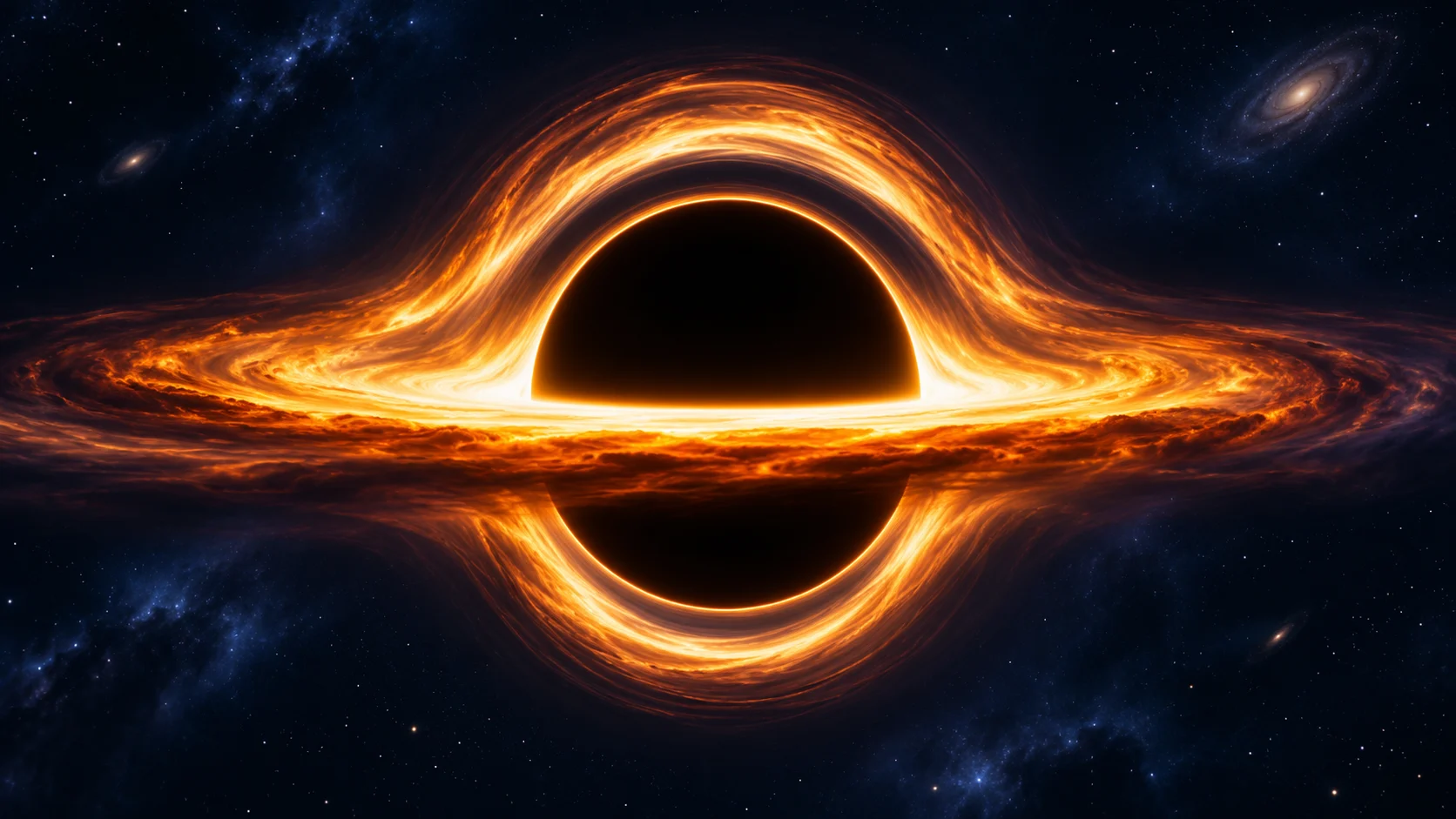
The horizon is also distinct from glowing material around some black holes. Gas can orbit outside and form a hot disc. Some black holes have little nearby material to feed on and can be very hard to see. A boundary in spacetime does not need an orange ring. The ring in an image comes from light emitted outside and bent on its way to the telescope.
Would you notice the moment you crossed it?
For a sufficiently large and quiet black hole, a freely falling traveller might cross without encountering a sudden local jolt at the horizon itself. Their clock would still tick. A small experiment inside the spacecraft would still operate locally. The moment would matter enormously for anyone hoping to send a message home, even if there were no visible line to mark it.
Meanwhile, the distant friend receives signals that left before the crossing. In the simplest idealised model, later pre-crossing signals become increasingly delayed and redshifted. The friend would see the spacecraft fade, rather than see a sharp final image of it stepping past a line. The traveller’s own time to the crossing is finite. The two accounts describe events measured from different positions and with different clocks.
Which signals would reach your friend?
Predict the outcome, then open each stage to check.
An outward pulse sent well outside
It can travel out and reach a distant receiver.
An outward pulse sent just before crossing
It may escape but reach the distant observer much later and at a lower frequency.
A pulse sent after crossing
It can travel locally inside the horizon. There is no future path that carries it to your friend outside.
You can picture this with a series of numbered postcards sent during the descent. Suppose the early cards arrive clearly and later ones arrive increasingly faint. There is a point after which a newly sent postcard no longer has a route to the recipient. The receiver's silence is about the route available to the message. It does not measure how fast the sender's watch is ticking beside them.
Why is a smaller black hole sometimes more violent at the edge?
The important effect is the difference in pull between nearby points. If your feet are closer to the black hole than your head, their motion can change faster in free fall. The difference stretches you along that direction. Across the other directions there can be compression. Physicists call these differences tidal forces. It is the same basic idea behind the Moon tugging more strongly on Earth's nearer side, taken to a much greater extreme.
For a non-spinning black hole, the horizon radius increases in proportion to mass. Stand at the horizon of a much more massive black hole in the mathematical model and you are much farther from the centre. There, the difference in gravity across a person can be smaller than at the horizon of a black hole formed from a star. Farther inward the differences can become enormous even for a very massive black hole.
The condition of the surroundings is its own question. Hot gas and radiation around an actively feeding black hole could present an extreme environment far from the horizon. The statement about a quiet crossing assumes a suitable path and surroundings. It tells us what the boundary itself does in a particular model.
What can physics tell us about the interior?
Einstein’s general relativity describes gravity as the shape of spacetime. In the simplest black-hole solution, future-directed paths inside the horizon lead towards smaller radius. In that model, a falling observer eventually reaches a singularity. The mathematics becomes extreme and it reaches a point beyond which the classical description cannot extend the path.
That conclusion is a statement about the theory and its assumptions. It does not give us a photograph or a complete physical account of matter at those conditions. A theory that combines gravity and quantum physics might describe something the classical equations leave out. Scientists have several research ideas, and direct observations from inside the horizon are unavailable.
Spinning black holes add complications. Their idealised mathematical interiors have features absent in the non-spinning model. Real disturbances and falling material may change those interiors substantially. A useful article about black holes starts with the simplest case and makes clear when an answer depends on it.
How do we know black holes are there?
Astronomers watch nearby stars orbit something massive that emits little light of its own. They measure high-energy radiation from hot material in some systems. Instruments also detect gravitational waves from pairs of compact objects spiralling together. Each method measures a different part of the environment, which helps build a picture from independent clues.
The Event Horizon Telescope can measure radiation from hot material around a black hole and reconstruct a ring-like image with a central shadow. Light bending and light capture help explain its appearance. The shadow and the horizon have related sizes in models, but they are different things. The instrument receives radiation that actually travelled to Earth.
Next time you see a glowing ring captioned as a black hole, ask where that light started and what happened on its way to the camera. The visible part can teach us about the invisible region. The same image sets a limit on what we can claim to have seen.
What is the shortest answer we can give?
Imagine returning to those spacecraft with three separate questions. Can the friend receive light from just outside the horizon? Some of it can escape, depending on the path. Can they receive a fresh signal from just inside? The definition of the horizon rules that out. Can a model still tell us what the traveller would experience? Yes, within the limits of the model. Those three answers let us keep observation, prediction and open questions straight.
Sources and further reading
Explore the other questions in this series