RM
Ronnie Mbuqe
Author · ExplainItSimply
31 July 2026
17 minute read
English
 The hook
Do you remember that strange silence?
You opened WhatsApp, typed a message and pressed Send. One tick appeared. Then nothing.
You checked your mobile data. You switched to Wi-Fi. You closed the app and opened it again. Some people restarted their phones as if the phone had personally offended them.
Then the messages started arriving from elsewhere: “Is WhatsApp down?”
Businesses could not answer customers. Families could not send updates. School groups went quiet. Voice notes sat waiting. Photos refused to move. Millions of people suddenly noticed something they normally never think about.
We do not usually notice software when it works. We notice it when it stops.
Think about it
How many times did you blame your own phone first?
That reaction tells us something important. Software works so quietly and so reliably that when a huge system fails, our first thought is often: “It must be me.”
Was my internet disconnected?
Did I run out of data?
Is my phone too old?
Did I accidentally change a setting?
Explain it simply
Software is not just an app
Software is a collection of instructions, rules and decisions that help computers solve problems for people.
WhatsApp is not only the green icon on your screen. Behind that icon are many connected systems responsible for identity, contacts, messages, encryption, storage, notifications, backups, calls, photos, videos and delivery status.
The app is the front door. The real building is hidden behind it.
Behind the scenes
What normally happens after you press Send?
1Your phone prepares the message
It identifies the conversation, time, sender and message type.
2The message is protected
WhatsApp uses end-to-end encryption so the message is intended to be readable only by the participants.
3Your phone sends it through the internet
The message travels through networks toward WhatsApp's systems.
4The system finds the recipient
Software checks which account and devices should receive it.
5The recipient's device receives it
If the device is offline, the system waits and tries again later.
6The ticks tell the story
Sent, delivered and read are different stages, not decoration.
Imagine if...
WhatsApp mixed up everyone's messages
You send “Good morning, Mom.” Your manager receives it. Your neighbour replies with a grocery list. Your dentist sends a laughing emoji.
It sounds ridiculous, but preventing that chaos is exactly what software rules are for. Every message needs the correct sender, correct recipient, correct conversation, correct order and correct delivery status.
IdentityWho sent this message?
DestinationWhich person and device should receive it?
StatusWas it sent, delivered or read?
When software fails
One small change can affect a huge system
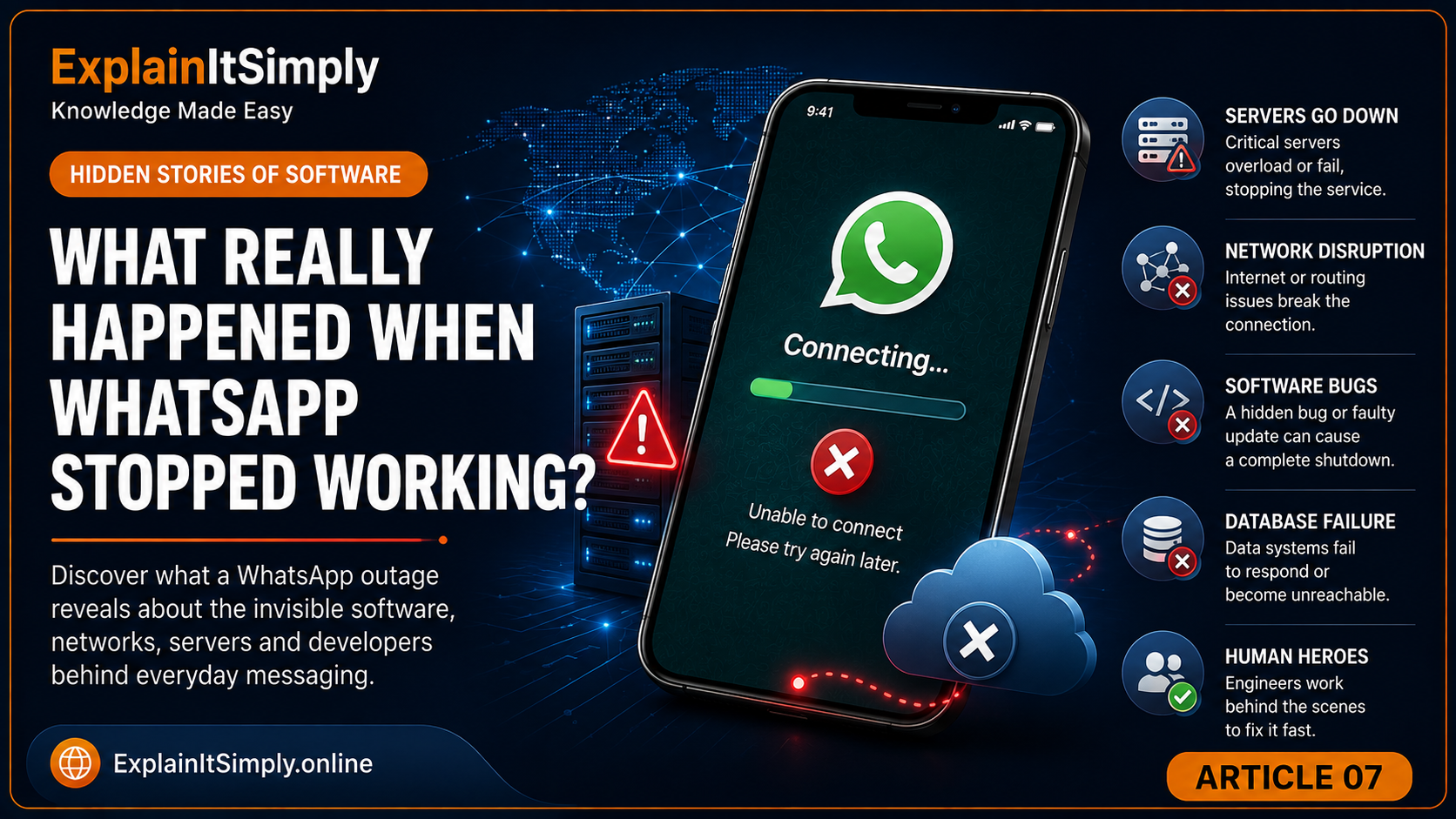
Large platforms depend on networks, routing, servers, databases, configuration and many internal services. If an important connection between those parts breaks, the app on your phone may still open while the hidden machinery behind it cannot complete its work.
This is why developers test changes, monitor systems, create backups and design recovery plans. They are always asking: “What happens if this part fails?”
The hidden heroes
Software developers do more than write code
Before a developer writes instructions, someone must understand the problem.
What if the user is offline?The message must wait safely.
What if Send is pressed twice?The recipient should not receive confusing duplicates.
What if a server fails?Another part of the system should continue where possible.
What if someone attacks the system?Security controls must protect accounts and data.
From a software developer
The code is not the first step
The first step is asking the right questions. Good software is built by thinking through ordinary use, unusual behaviour, mistakes, failures and risks.
A user sees one button. A developer sees every possible thing that might happen after it is pressed.
The bigger story
WhatsApp was only the moment we noticed
From the moment you wake up until you go to sleep, software quietly solves hundreds of problems you probably never notice.
It wakes you with an alarm, unlocks your phone, checks the weather, processes your card payment, finds traffic, recommends music, stores your photos and remembers where you stopped watching.
ExplainItSimply reveals the hidden stories behind the technology people use every day.
Count the invisible helpers
Tomorrow, notice every moment software helps you. Each alarm, message, search, payment, map, video and notification is another hidden story.
Next time WhatsApp works normally, pause for one second. Behind that simple green button is an enormous world quietly doing its job.
Over coffee
Ask someone this question
“What do you think happens after you press Send on WhatsApp?”
You may be surprised by how many different answers you hear.
What could go wrong?Why can one failure affect so many people?
Large systems are built from connected services. One handles identity, another messages, another media, another notifications and another routing between networks.
If an important shared service becomes unavailable, several visible features may fail together. The app can still open because the front door is on the phone, while the services behind that door cannot complete their work.
This is why engineers try to isolate failures, keep backup routes and design systems that degrade safely instead of collapsing completely.
The recovery storyBringing a global service back is not one restart button
Teams first need to understand what failed. They then restore essential connections, confirm that databases and services agree, gradually return traffic and watch for a second failure caused by everyone reconnecting at once.
Recovery must be careful. A rushed repair can create duplicated work, lost updates or another outage.
The hidden heroThe monitoring screen nobody sees
Before users report a problem, monitoring systems may already be showing unusual errors, slow responses or disconnected services.
Logs, alerts and dashboards help engineers answer the first urgent questions: What broke? When did it begin? Which regions are affected? What changed immediately beforehand?
When software is invisible, monitoring becomes the eyes and ears of the people responsible for it.
More hidden software stories
The silence did not only reveal an outage.
It revealed how deeply software has become part of ordinary life.
Ordinary moment. Extraordinary software story.
🤔 The Next Time...
The next time WhatsApp suddenly goes quiet
Before restarting your phone, remember that the visible app depends on networks, servers, routing and many connected services.Which hidden part of the system may have stopped doing its job?