
By Ronnie Mbuqe
Revenue is the money earned from sales; profit depends on the costs of earning it. Materials, delivery, platform fees and other expenses can consume the selling price.
For a fictional R100 sale with R70 materials and R20 delivery, only R10 remains before other costs and tax. A full order book does not change that arithmetic.
The idea in everyday language
Popular Side Hustle Ideas
-
Freelancing: Writing, graphic design, web development, consulting.
-
Online Selling: eCommerce, Etsy shops, dropshipping.
-
Gig Economy: Driving, delivery, pet sitting, handyman services.
-
Content Creation: YouTube, TikTok, blogging, podcasts.
-
Teaching & Coaching: Tutoring, online courses, fitness coaching.
-
Investments & Trading: Stocks, crypto, rental income (requires research and risk awareness).
Getting Started
Starting a side hustle doesn’t require massive resources. Focus on your skills, identify a market need, and start small. Here’s a practical approach:
- Identify your skills and interests.
- Research demand and competition.
- Create a simple plan and set goals.
- Start part-time, track progress, and refine your offering.
- Use social media and online marketplaces to reach customers.
Key Success Tips
- Time management is critical: balance your main job and side hustle without burnout.
- Focus on quality and reliability, reputation grows your business faster than ads.
- Learn basic marketing, social media, and customer service.
- Document finances from day one, separate business and personal accounts.
- Scale gradually: reinvest profits into tools, education, or marketing.
Side Hustles & Taxes
Side income is taxable. Keep careful records, save for tax payments, and understand deductions related to your side business. Refer to Taxes Made Simple for guidance.
Scaling Your Side Hustle
Once you’ve validated your side hustle, consider ways to scale:
- Automate processes with software and tools.
- Outsource tasks to freelancers or contractors.
- Expand product or service offerings.
- Leverage social media and email marketing.
- Consider forming a small business entity for growth and tax benefits.
Mindset for Side Hustle Success
Persistence, adaptability, and curiosity are critical. Treat your side hustle as a learning opportunity, not just a money-making project. Many full-time careers have been launched from side hustles.
Can a busy side business still lose money?
Revenue measures sales, while profit requires subtracting relevant costs.
Trace the explanation
Materials, delivery, transaction fees and time can change whether an idea is worthwhile. A crowded order book is not enough evidence by itself.
Source and further reading: www.sba.gov
A Side Hustle Is A Small Business Test Before It Is Extra Income
A side hustle sounds simple because the work happens beside a main job or studies, but the economics still need to work. Revenue is not profit. If you sell R5,000 worth of products and spend R3,500 on stock, delivery, platform fees and advertising, the business created R1,500 before considering your time and tax obligations.
Time is often the hidden cost. A service that earns R400 but requires six hours of travel, messaging, preparation and delivery may pay less per hour than it first appears. Tracking the complete job from enquiry to payment gives a more honest view of whether the hustle is worth expanding.
The safest starting point is usually a small experiment. Instead of buying large amounts of stock, test whether real customers will pay. Instead of building a complex website for months, offer the service manually to a few people and learn what they actually value. Evidence from customers is more useful than compliments from friends.
A side hustle also needs boundaries. If it uses an employer’s time, data, customers or intellectual property, you may create legal or employment problems. Check your contract, protect customer information and keep business money separate enough that you can understand what the activity truly earns.
Cash flow can kill a profitable idea
A business can make a profit on paper yet run out of cash if customers pay late while suppliers must be paid immediately.
Repeat customers are powerful
Selling again to someone who already trusts you can cost less than finding a new customer every time.
Scaling can reduce quality
More orders are only good if the process can deliver them without missed deadlines, poor service or burnout.
Revenue can rise while the owner earns almost nothing
Suppose ten orders bring in R2,000. If materials cost R900, delivery R300 and other direct costs R200, R600 remains before other overheads and tax. If the work took 20 hours, that is R30 per hour before those remaining costs.
These are invented teaching figures, not a suggested market price. The point is to count time, failed orders and customer communication alongside the visible sale. A busy order list is not automatically a viable business.
Sell a small real offer to Adjust before scaling
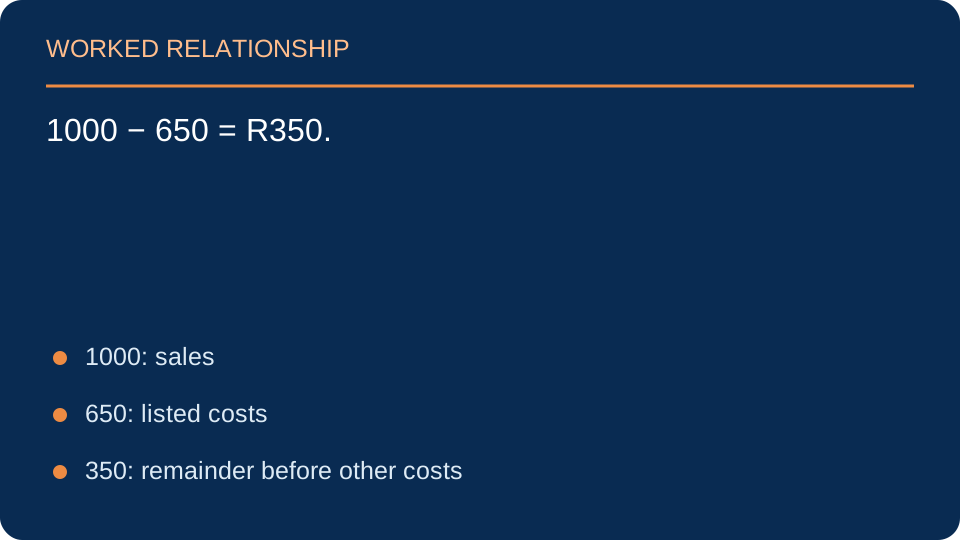
A fictional batch sells for R1000 and costs R650 in materials and delivery. What remains before other costs and taxes?
Trace the explanation
1000 − 650 = R350. This is a contribution after the listed costs, not necessarily final profit. Equipment, fees and labour may still need accounting.
Source and further reading: www.sba.gov
Why can taking more orders make the cash problem worse?
Supplies may need to be paid for before customers pay. Growth can increase the amount tied up between buying materials and collecting income.
Map one order from purchase to payment, including delays and refunds. Capacity and cash timing matter alongside whether the advertised price appears profitable.
Check your grasp of side-hustle basics
Try this question using the ideas from this article. Open the explanation after choosing your answer.
Question 1
A side hustle brings in R5,000 in sales and costs R3,500 for stock, delivery and other expenses. What is the best interpretation?
A. The business has R5,000 profit
Show explanation
Sales revenue is not the same as profit.
B. R1,500 remains before any other uncounted costs or tax obligations
Show explanation
Correct. Subtract known costs, then check whether other expenses, time, refunds and tax still need to be accounted for.
C. The business must be successful because sales occurred
Show explanation
Sales alone do not show whether the activity is sustainable or worthwhile.
Explain it in your own words
Name one cost besides stock that a small side business should track, and explain why.
Compare with a model answer
Examples include delivery, data, packaging, platform fees, equipment, travel, refunds or the value of time spent. Tracking costs shows whether the business is actually earning enough.
Test demand before buying the equipment for the business you imagine
Start with a small offer you can deliver reliably and ask real potential customers whether they will buy it at the proposed price. Compliments and social-media likes are weaker evidence than actual paid demand. Keep the test small enough to learn without a large irreversible spend.
Record what customers asked for, what delivery required and why people declined. Adjust the offer based on that evidence. Also check relevant registration, tax and employment obligations through current official guidance rather than assuming a small activity has no rules.
If you double sales, must profit double too?
No. Costs, capacity, discounts and errors can change as volume grows. Separate revenue, variable costs, fixed costs and your time before forecasting the result.
Common questions on side hustles
What is the first step before starting a side hustle?
Test whether a real person will pay for the result, using the smallest possible version of the idea, before investing in branding or stock.
How much money should I invest before validating an idea?
As little as possible, spend on proving demand first, and only expand once you have paying customers.
Can a side hustle run alongside a full-time job?
Yes, many do, though it requires managing time carefully and checking any restrictions in your main employment contract.
When should a side hustle become a full-time focus?
Once income is consistent enough to replace your main income and the workload is sustainable at that scale.
Do I need to register a business immediately?
Legal and tax requirements depend on where you live and what you are doing. Start by checking the official rules that apply to your activity and income.
How do I price a service?
Consider the value to the customer, market alternatives, your costs and the time required. Hourly pricing is one method, not the only one.
When should I stop a side hustle?
If demand is weak, margins remain poor, the work conflicts with important obligations or the opportunity cost is too high, stopping can be a rational decision.
Should I borrow money to start?
Be cautious. Test demand as cheaply as possible before taking debt for an unproven idea, especially when repayments are fixed but sales are uncertain.
You could double orders but would need paid delivery help. What should you calculate before accepting them?
One reasoned response
Estimate the extra revenue and extra costs, capacity and time required. More sales can improve income or amplify an unprofitable process, depending on the margin.
Source and further reading: www.sba.gov
Validate demand before spending money
A side hustle is a small business activity alongside other responsibilities. The first question is not “What can I sell?” but “Who has a problem I can solve, and what evidence shows they will pay for the solution?” An idea is a hypothesis until real customers respond.
Test the idea in small steps
- Name a specific customer. “Everyone” is not a useful target. A clearer group might be local small businesses that need simple menus or parents who need weekend tutoring.
- Describe the problem. What is inconvenient, expensive, slow, confusing, or currently unavailable?
- Talk to potential customers. Ask how they handle the problem now and what they have already paid for. Compliments are weaker evidence than a real purchase or a clear commitment.
- Offer a small version. Test one service, limited batch, or prototype before buying equipment or large stock.
- Calculate the full cost. Include materials, delivery, platform fees, transport, packaging, tax obligations, and your time.
- Review the result. Record enquiries, completed sales, repeat customers, profit, and hours worked.
Understand the difference between sales and profit
If you sell a product for R200 and spend R90 on materials, R25 on delivery, and R15 on platform and payment fees, R70 remains before other overheads and tax. If the job took three hours, that remaining amount is not automatically a good return. Your time has value, and repeat work may have different costs from the first sale.
Set stop rules before enthusiasm takes over
Decide how much money and time you can afford to risk, how many customer conversations you will complete, and what evidence would make you stop or change the offer. Do not borrow heavily based only on optimistic forecasts. Check relevant registration, permits, consumer-protection, tax, and safety requirements before trading.
Protect your main responsibilities and avoid promises you cannot meet. A small, repeatable service with satisfied customers is usually stronger evidence than a large social-media following with no paying demand.
Further reading: Small Enterprise Development Agency (SEDA) provides South African small-business support resources. Verify current requirements with the relevant official authority for your activity.
Sources
Sources and further reading
A closer lookBusy is not the same as profitable
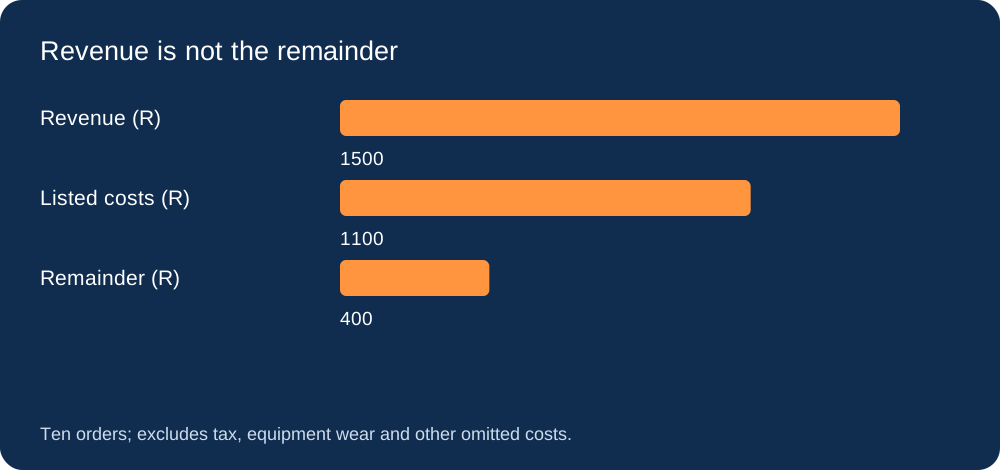
Ten orders sell for R150 each. Materials cost R80 per order, packaging costs R10 per order and transport costs R200 for the batch. Revenue is R1,500; these stated costs total R1,100.
Work through the distinction
The R400 remainder is before tax, equipment wear and any other omitted costs. If the batch takes eight hours, that is R50 per hour before those omissions. Record failed orders and time spent finding customers as well as production time.
What remains after the listed costs?
Choose an answer to see feedback. You can try again.
Show the answer and explanation
R400. The R400 remainder is before tax, equipment wear and any other omitted costs. If the batch takes eight hours, that is R50 per hour before those omissions. Record failed orders and time spent finding customers as well as production time.