By Ronnie Mbuqe
A budget total describes amounts over a period. Cash flow also tracks when money enters and leaves the account.
If rent goes off before income arrives, the monthly sum can look affordable while the timing fails. Put expected payments on a calendar as well as in categories.
Start with the plain-language version
A budget isn't about restriction - it's about making intentional choices with your money.
Why can a positive bank balance still mean money is unavailable to spend?
A balance is a snapshot, while a budget tracks obligations over time.
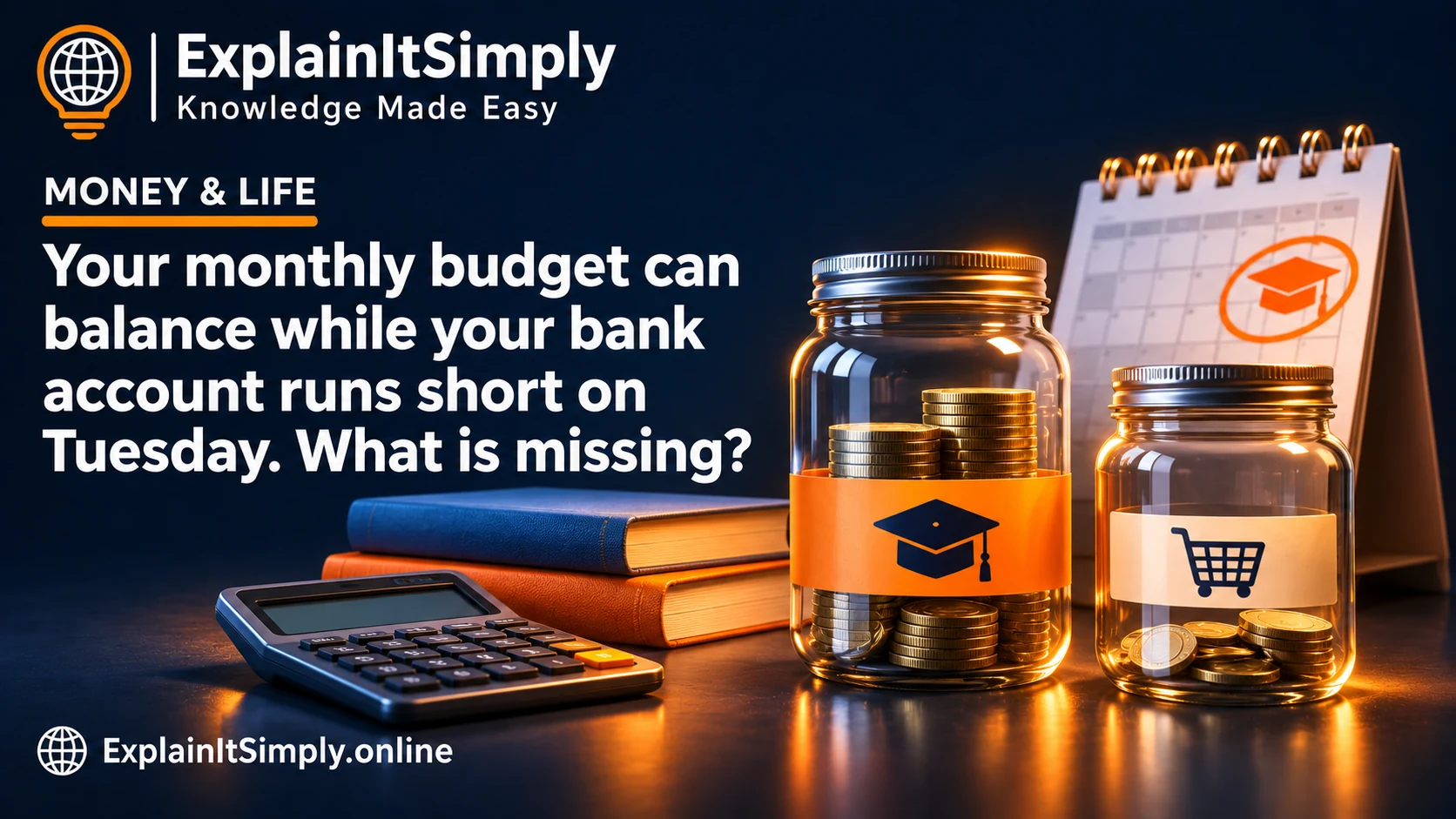
 Original ExplainItSimply illustration; conceptual, not a scale drawing.
Trace the explanation
Rent due tomorrow still matters even when the debit has not happened. Separate committed money from genuinely unallocated money before judging what is available.
Source and further reading: Consumer Financial Protection Bureau
A Budget Is A Decision Map, Not A Punishment
A useful budget starts with the money that actually arrives in your account, not the salary figure people quote before deductions. From there, separate commitments such as rent, transport, debt repayments and school costs from flexible spending such as takeaways, entertainment and impulse purchases. The point is not to remove every enjoyable thing. It is to make sure the important things are protected before the month becomes noisy.
Say R18,000 reaches your account after deductions. If rent is R6,000, transport R2,500, groceries R3,000, insurance R900 and debt repayments R1,600, then R14,000 is already spoken for. That leaves R4,000 for electricity, data, school needs, emergencies, saving and everything else. Seeing the whole picture early is much safer than discovering on the 24th that several small purchases used money that was meant for an essential bill.
A budget also needs categories for costs that do not arrive every month. Car licences, school uniforms, annual subscriptions, birthdays and December travel are predictable even if they are not monthly. Dividing an expected yearly cost by twelve turns a future shock into a manageable monthly amount. This is often called a sinking fund.
When a budget does not balance, the answer is not to pretend the shortfall will disappear. You have only a few real levers: reduce a cost, delay a goal, increase income, renegotiate an obligation or use existing savings. Borrowing to cover a permanent monthly shortfall usually makes the next month harder because the repayment becomes another fixed commitment.
50/30/20 is a guide, not a law
Rules such as 50% needs, 30% wants and 20% saving can be useful starting points, but real households differ. High rent, family responsibilities or debt can make those percentages unrealistic. Your budget should reflect your actual obligations and priorities.
Emergency money needs a job too
An emergency fund is not simply “extra cash”. Its job is to protect you from having to borrow when something necessary breaks, income stops briefly or an urgent expense arrives.
Small leaks matter when repeated
R80 spent casually three times a week is roughly R1,000 a month. The individual purchase may be harmless; the repeated pattern is what changes the budget.
A balanced month can still run out of money on the 12th
Suppose R10,000 arrives on payday and total monthly spending is R9,500. The plan has a R500 surplus, but that does not mean every payment date is covered. If major bills fall before the next income arrives, timing matters as well as totals.
Write the opening balance, expected incoming amounts and payment dates on one calendar. Then follow the balance through the month. A budget is both a spending plan and a cash-flow story; the monthly sum cannot show a temporary shortfall hidden between two dates.
Income arrives on dates to Balance changes between them
Why does an annual bill make an ordinary month feel unusually expensive?
The expense belongs to the year even when the payment happens once. Ignoring it in other months hides the amount needed to prepare.
For a fictional R1,200 yearly bill, setting aside R100 a month builds the amount over twelve months. Actual timing and existing savings determine whether that simple plan is enough.
Check your grasp of budgeting basics
Try this question using the ideas from this article. Open the explanation after choosing your answer.
Question 1
Your take-home pay is R18,000. Listed expenses total R14,000, but you have not planned for annual school costs or car repairs. What is the best next step?
A. Spend the remaining R4,000 because the budget balances
Show explanation
Irregular expenses still need to be planned for; the apparent remainder may not be free to spend.
B. Set aside realistic amounts for irregular costs before deciding what is available
Show explanation
Correct. Convert predictable occasional costs into monthly amounts where possible, then review what remains.
C. Ignore the costs until they happen
Show explanation
That can force borrowing or disrupt other bills when the costs arrive.
Explain it in your own words
Name one expense that does not happen every month and explain how you could prepare for it in a budget.
Compare with a model answer
Examples include school uniforms, vehicle licensing, annual insurance or home repairs. Estimate the likely cost and set aside a manageable amount regularly.
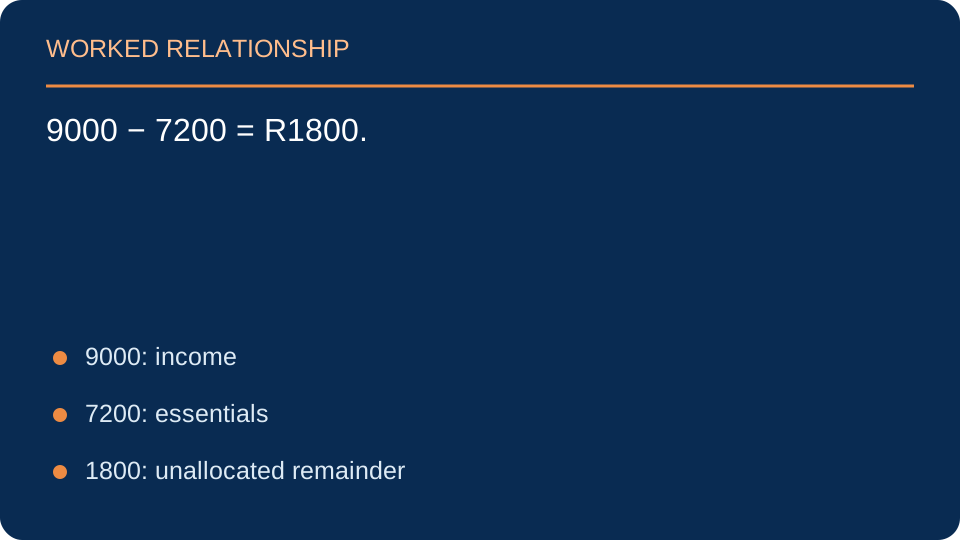
A fictional month has R9000 income and R7200 planned essential costs. What remains before other spending and saving?
Trace the explanation
9000 − 7200 = R1800. This remainder is not automatically disposable: irregular costs and savings goals may still need allocations. Use the same time period for both figures.
Source and further reading: Consumer Financial Protection Bureau
Frequently Asked Questions
Common questions on budgeting
What is the simplest way to start a budget?
List your income and fixed expenses first, then assign what is left to savings and flexible spending before the month begins.
How often should I review my budget?
At least once a month, and again whenever your income or major expenses change.
What should I do if I keep overspending in one category?
Track that category closely for a few weeks to see where the spending actually happens, then adjust the budgeted amount or the habit driving it.
Is a strict budget the only option?
No. Some people prefer percentage-based rules or automatic transfers, which need less day-to-day tracking than a line-item budget.
Should fun money be included?
Yes. A plan that ignores all discretionary spending is often unrealistic. Decide what you can afford and include it deliberately.
What if income changes every month?
Base essential commitments on a conservative income estimate and build a buffer in stronger months. Irregular income makes cash reserves especially useful.
What is a sinking fund?
It is money set aside gradually for a known future cost such as car maintenance, school expenses or an annual subscription.
Sources
Sources and further reading
An annual bill is not a surprise if it happens every year
An illustrative R2,400 yearly cost can be represented by setting aside R200 each month. This does not reduce the cost, but it changes a large occasional demand into planned smaller allocations. Keep this separate from genuinely uncertain emergencies.
If the arithmetic shows a shortfall, identify the size before choosing a response. Cutting an optional subscription may help, but a small saving cannot solve a much larger structural gap. The calculator lets you compare income, essentials, other spending and planned saving without sending your figures anywhere.
If a credit-card purchase has not left your bank account yet, is it absent from the budget?
No. It creates an obligation to pay later. Record the spending and the repayment timing so the same available income is not allocated twice.
You receive weekly pay but rent is monthly. How would you avoid treating every payday as a new spending allowance?
One reasoned response
Reserve money toward the monthly commitment on each payday. Compare actual payment dates, not just average totals. A budget needs both amounts and timing.
Source and further reading: Consumer Financial Protection Bureau
Build a budget around a realistic base month
A budget is a plan for when money arrives and when it must leave. It is not a test of discipline, and it cannot make income cover costs that are consistently higher than income. A useful budget makes the gap visible early enough to adjust, ask for help, or negotiate a payment date.
Start with what is dependable
Write down take-home income you can reasonably rely on. If you earn commission, casual wages, or seasonal income, use a cautious baseline rather than your strongest month. List fixed essentials such as housing, basic utilities, transport to work or school, and minimum required repayments. Then add variable essentials such as groceries and electricity, followed by irregular expenses that do not arrive every month.
Turn irregular expenses into monthly amounts
If school costs R1,200 twice a year, it averages R200 per month across six months. If a vehicle service is expected to cost R3,600 annually, setting aside R300 per month can make the bill less surprising. These averages do not solve a cash-flow gap if the expense is due before the money has been saved, so plan for the actual dates too.
Use a weekly check-in
- Compare actual spending with the plan.
- Check upcoming debit orders and due dates.
- Update any amount that changed.
- Choose one adjustment that is realistic for the coming week.
If the numbers do not balance
Separate costs that can be changed quickly from those that need a longer plan. Contact a provider before missing a payment if you need to discuss options. Do not treat a new high-interest loan as extra income. If you are supporting a household, include shared responsibilities and agree on who will pay which bill where that is safe and practical.
A budget should be reviewed as circumstances change. A plan that was realistic last month may no longer fit after a price increase, job change, school expense, or family emergency.
Further reading: Financial Sector Conduct Authority offers South African consumer financial information.
A closer lookThe R600 that belongs to next month
Lindi has R2,000 left after regular bills. Her annual school expense of R3,600 falls due in six months. Setting aside R600 now leaves R1,400 for other decisions, even though the bank still displays R2,000.
Work through the distinction
Separate the account balance from money already committed. If she waits until the bill arrives, six months of apparent spare cash will have hidden a predictable obligation. The R600 is a planned allocation, not a new expense added to the R3,600.
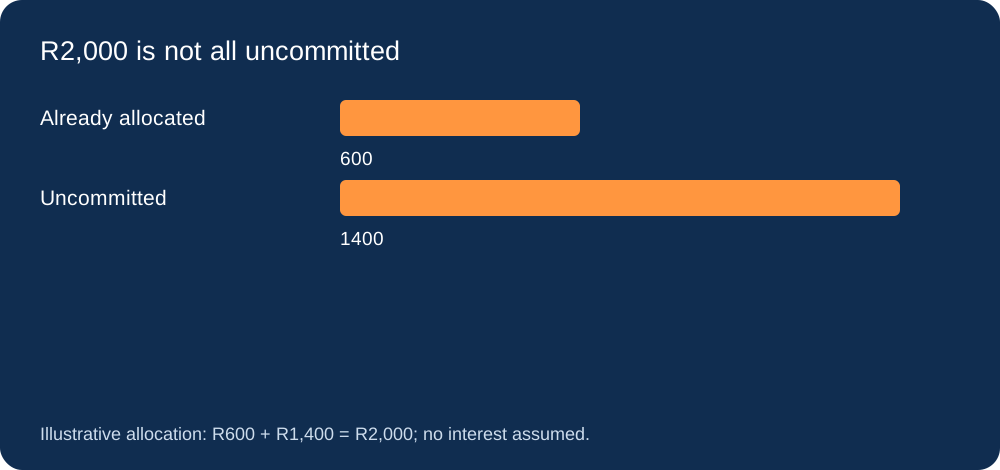
How much is uncommitted after setting aside this month's R600?
Choose an answer to see feedback. You can try again.
Show the answer and explanation
R1,400. Separate the account balance from money already committed. If she waits until the bill arrives, six months of apparent spare cash will have hidden a predictable obligation. The R600 is a planned allocation, not a new expense added to the R3,600.