Why might a very broad question produce an answer that still feels unhelpful?
Break a broad request into the concept, mechanism and application you actually need.
Trace the explanation
A precise follow-up makes a missing link visible. Keep your original goal in view so that detail serves understanding rather than becoming a distraction.
Source and further reading: The Learning Scientists
Frequently Asked Questions
Questions About ExplainItSimply
These questions explain the purpose of the website,
who it is for, what the platform covers and how the
content is created and used.
What is ExplainItSimply?
ExplainItSimply is a learning platform that makes
complex topics easier to understand through plain
language, familiar examples and step-by-step
explanations. The aim is not simply to give a
definition, but to help a reader understand what
something is, why it matters, how it works and
where it appears in real life.
Who is ExplainItSimply for?
It is for students, parents, professionals,
job seekers, beginners and curious readers who
want useful explanations without unnecessary
jargon. A reader does not need a technical
background before starting. The explanations
are designed to build understanding from the
basics and then add useful detail.
What topics does the site cover?
The platform covers Artificial Intelligence,
software development, space and astronomy,
aviation, school and learning, money and life
skills, careers and other subjects that connect
to everyday life. The topics are deliberately
connected because understanding one subject
often makes another easier to understand.
Is ExplainItSimply free to read?
Yes. The public educational guides and articles
are available for readers to explore without
payment or a required account. The public site
is intended to provide useful knowledge to
students, families, workers and the wider
community.
Why was ExplainItSimply created?
ExplainItSimply was created because information
is everywhere, but clear understanding is not
always easy to find. A person can search for
an answer and still finish with more questions
than they started with because the explanation
assumes too much knowledge or uses language
that was never explained.
The platform tries to solve that problem by
starting with the real question, explaining
the important background and then showing how
the idea connects to everyday life.
How do you make complicated information simple?
We start with the basic idea and avoid assuming
that the reader already knows the terminology.
The explanation then builds logically through
the process, uses familiar examples and connects
the subject to situations people recognise.
The objective is simple language without removing
the important meaning.
Does simple mean the information is shallow?
No. Simple language and shallow information are
not the same thing. A difficult subject can still
require detail, conditions, examples and context.
ExplainItSimply aims to remove unnecessary
difficulty while keeping the important information
needed to understand the subject properly.
Can I suggest a topic?
Yes. Readers can use the Contact page to suggest
a topic, share feedback, report a problem or
recommend an idea that should be explained more
clearly. A specific question is especially useful
because it helps identify exactly what the reader
is trying to understand.
Can I report a factual mistake?
Yes. If you believe something is incorrect,
please use the Contact page and include the
article name, the statement that concerns you
and, where possible, a reliable source or
explanation showing why it should be reviewed.
Clear correction information makes it easier
to investigate the issue properly.
Who creates and reviews the content?
ExplainItSimply was created by Ronnie Mbuqe,
a software developer and lifelong learner.
The content is developed around questions
people actually ask and is reviewed with
attention to clarity, usefulness, accuracy
and whether the explanation genuinely adds
understanding.
Does ExplainItSimply use Artificial Intelligence?
Technology can assist with research, organisation,
editing and other parts of the publishing process,
but that does not remove the need for human
judgement. Information still needs to be checked,
structured and presented in a way that genuinely
helps the reader understand the subject.
Can I trust every explanation without checking elsewhere?
ExplainItSimply aims to provide accurate and useful
educational information, but no general educational
website should replace qualified professional advice
for high-stakes decisions. Medical, legal, financial,
safety and other important decisions should be checked
against appropriate official or professional sources.
Can I share an ExplainItSimply article?
Yes. Readers are welcome to share links to the
published pages with friends, students, colleagues,
family members or anyone who may find the explanation
useful. Sharing the original page also helps readers
access the latest version if an article is updated.
Why are the explanations sometimes long?
The length depends on the subject rather than an
arbitrary word count. A simple definition may only
need a few paragraphs, while subjects such as AI,
software, space, finance or careers may need
examples, comparisons, background and practical
context before the reader can properly understand
the idea.
What happens if my exact question is not on the site?
Try describing the question using ordinary language
rather than trying to guess the technical terminology.
If the subject is genuinely missing, you can suggest
it through the Contact page. Those suggestions help
identify questions that deserve a useful explanation
rather than creating pages simply to fill space.
Why does the website connect different subjects?
Real-world systems rarely belong to only one subject.
A flight involves software, weather, navigation,
communication and human decision-making. A payment
involves money, databases, networks, security and
software. Understanding these connections helps
readers build a bigger picture instead of learning
isolated definitions.
What is the Learning & Career Hub?
The Learning & Career Hub is the broader learning
experience being developed around the public
ExplainItSimply content. It is intended to help
learners move from reading an explanation to
saving useful information, revisiting questions,
tracking learning and exploring possible study
and career directions.
What is Career Pathfinder?
Career Pathfinder is a discovery tool rather than
a system that chooses a career for someone. It
connects current subjects or modules with interests
and strengths to identify possible study and career
directions worth investigating.
For school learners, the journey can connect Grade
8–12 subjects to possible courses and careers.
For tertiary learners, it can connect qualifications
and modules to work areas and possible entry roles.
Users can also compare possible career directions
rather than being told that one answer is automatically
correct.
Do I need an account to read the public content?
No. Public readers can access the educational
content without creating an account. Account-based
features are intended for people who want additional
tools around their learning rather than being a
requirement for accessing the core public knowledge.
What is the main idea behind ExplainItSimply?
The main idea is simple: people should be able to
understand the systems that affect their lives.
Technology, AI, education, careers, money, science
and everyday digital services should not feel
inaccessible simply because the explanation was
written in complicated language.
Meet the Author
Share ExplainItSimply
Help someone else understand it
Choose where you want to share this explanation. The page title, description and link will travel with it where the platform supports previews.
Found this helpful?
Help someone else understand this topic.
A clear explanation can be useful to a learner, parent, colleague or friend. Share this page so they can read the full explanation in their own time.
A support question says only it does not work. Which detail would most improve the investigation?
Trace the explanation
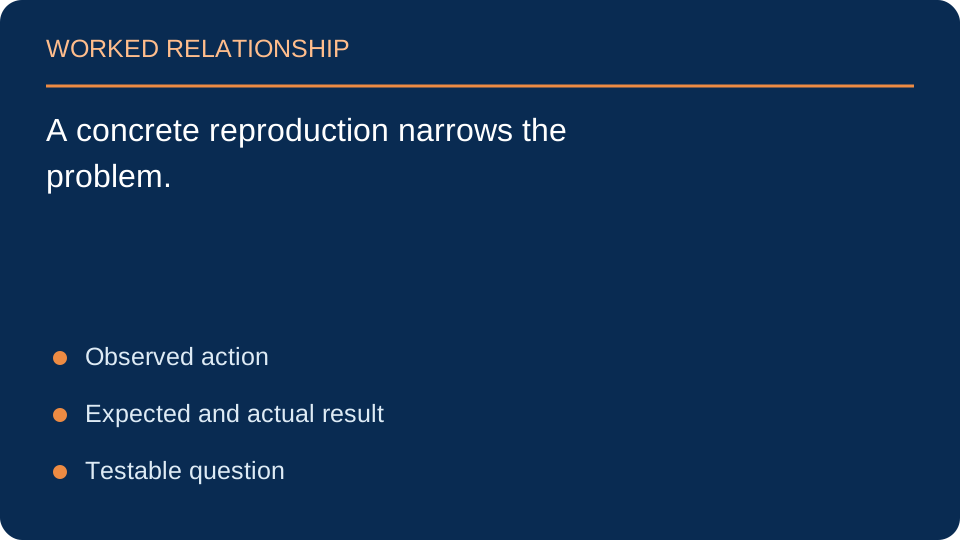
A concrete reproduction narrows the problem. Add the environment and when it happens, and separate what you observed from your theory about the cause. That gives a respondent something testable.
Source and further reading: The Learning Scientists
How would you improve the question Why does my app not work?
One reasoned response
Name the action, expected result, actual result and when the issue occurs. This gives the explanation a concrete starting point and reduces unrelated guesses.
Source and further reading: The Learning Scientists