RM
Ronnie Mbuqe
Author · ExplainItSimply
27 August 2026
11 minute read
English
Start here
People were talking about the eclipse on 28 August 2026. But what did we actually see?
Your attention is on the Moon.
During the eclipse, a dark curved area moved slowly across it. The same thing happens whenever the Moon passes through Earth's shadow during a lunar eclipse.
What is that dark area?
It is Earth's shadow — the shadow of the same planet you are standing on.
Why does Earth's shadow reach the Moon?
Because the simple order during a lunar eclipse is:
Sun → Earth → Moon
Earth is between the Sun and the Moon. It blocks some of the sunlight that would normally light the Moon.
So what are we really watching?
We are watching the Moon move through Earth's shadow.
That is a lunar eclipse in one simple picture — and that explanation stays true before, during and long after this particular event.
You might be wondering...
Why did this eclipse happen on 28 August 2026?
Why does only part of the Moon become dark during a partial eclipse?
Why can the Moon look reddish?
Where could South Africa see this event?
And how can the Moon still be visible while the Sun is beginning to rise?
1 · WHAT?
So what exactly is a lunar eclipse?
The Moon does not make its own light. It looks bright because sunlight reaches the Moon and reflects back toward us.
During a lunar eclipse, Earth moves between the Sun and the Moon. Earth blocks some of that sunlight and makes a shadow in space. When the Moon moves into that shadow, part of the Moon becomes dark.
☀️ SUN
→
🌍 EARTH
→
🌕 MOON
This is the most important picture to remember: Earth is in the middle.
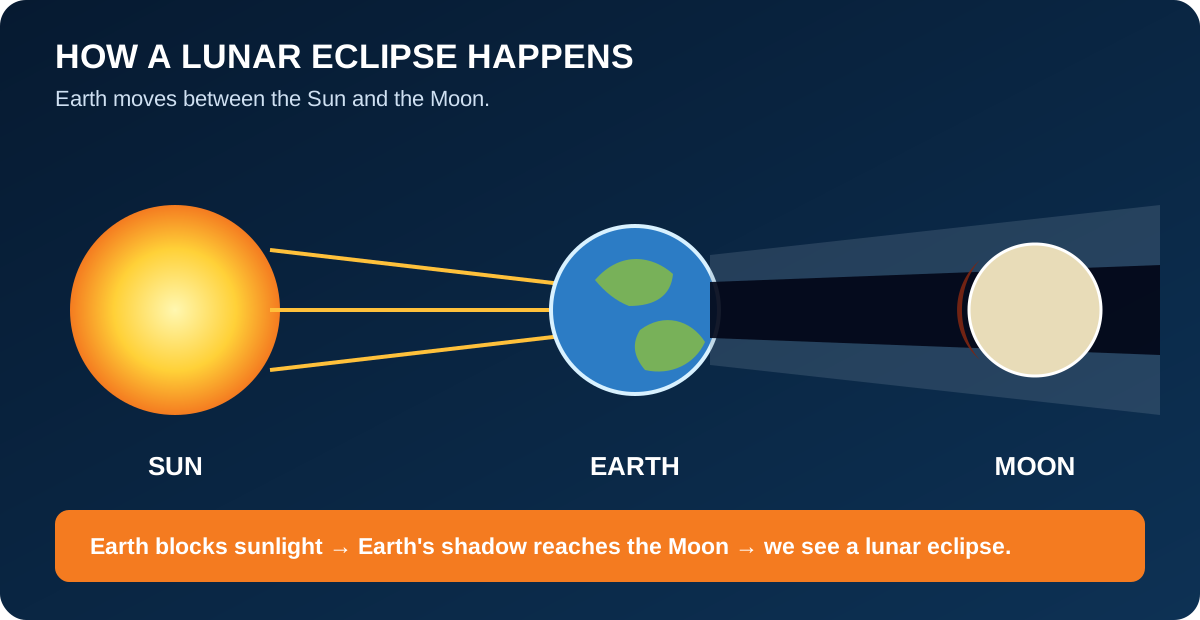 Earth is in the middle: sunlight is blocked, Earth's shadow stretches into space, and the Moon moves into that shadow.
Start with the simplest picture
Imagine standing outside at night with the Sun far behind Earth and the Moon on the other side of our planet. Sunlight normally travels past Earth and lights the Moon. During a lunar eclipse, however, the Moon moves into the long shadow that Earth makes in space. We see part of the Moon become darker because Earth is blocking some of the sunlight that would normally reach it.
Nothing is crashing into anything. The Moon is not switching off, disappearing or suddenly changing shape. The event is simply light, shadow and movement happening on a very large scale.
2 · HOW?
Wait... that dark part on the Moon is caused by Earth?
Yes. When you see the dark curved area spreading across the Moon, you are seeing Earth's shadow. That is the key thing to understand.
Think about a shadow you already know.
Stand outside with the Sun behind you. Your body blocks some sunlight. On the ground in front of you, a shadow appears.
Earth does the same thing. Sunlight shines on Earth, Earth blocks some of it, and a huge shadow stretches into space behind our planet.
TRY IT YOURSELF
Torch + ball + wall
You can make a simple model of a lunar eclipse at home. You only need a torch, a ball and a wall in a darker room.
Torch = Sun
Ball = Earth
Shadow = Earth's shadow in space
1
Shine the light
Point the torch toward the ball. The torch is acting like the Sun sending light toward Earth.
2
Look behind the ball
The ball blocks some of the light. A dark shadow appears on the wall behind it.
3
Move something through the shadow
Use a smaller ball or round object as the Moon and slowly move it through the shadow behind the larger ball.
What should you notice?
The shadow does not cover your little “Moon” everywhere at once. It moves across it gradually. That is similar to what we see during a lunar eclipse as the real Moon moves through Earth's shadow.
The important idea: Earth does not need to touch the Moon. It only needs to block the Sun's light. When the Moon moves into that shadow, we see a lunar eclipse: Sun → Earth → Moon.
So what is actually moving?
The Moon is travelling around Earth. As it moves along its orbit, it can enter Earth's shadow and later move out again.
Why can Earth make a shadow in space?
Anything that blocks light can make a shadow. Your body makes one when sunlight shines on you. A tree makes one on the ground. Earth does exactly the same thing, except Earth is enormous and the light source is the Sun. The side of Earth facing the Sun is illuminated while a long region behind Earth receives less or no direct sunlight.
The Moon keeps moving along its orbit around Earth. If that orbit carries the Moon through Earth's shadow at the right time, we see a lunar eclipse. This is why the simple order Sun → Earth → Moon is so useful: it tells you immediately that Earth is the object blocking the light.
3 · WHY NOW?
Why did this happen on 28 August 2026?
The Moon travels around Earth all the time. Earth also travels around the Sun. If you want to explore more after this explanation, visit our Space & Universe learning section. Because everything is moving, the positions of the Sun, Earth and Moon keep changing.
On 28 August 2026, the Moon reaches a place in its orbit where the Sun, Earth and Moon line up closely enough for the Moon to move through Earth's shadow.
That alignment is the reason we get an eclipse on this particular date.
?
Does Earth suddenly move into a special place?
No. Earth and the Moon are always moving. An eclipse happens when their normal journeys happen to put the Sun, Earth and Moon into the right alignment at the same time.
So why does the date matter?
Earth and the Moon never stop moving. Earth travels around the Sun while the Moon travels around Earth. Most of the time their positions do not place the Moon inside Earth's shadow. On 28 August 2026, their normal journeys bring them into the required geometry while the Moon is full.
The date is therefore not caused by Earth suddenly moving somewhere unusual. Astronomers can predict eclipses because the motions of Earth and the Moon are regular enough to calculate far in advance. The eclipse is a predictable meeting of orbital position, light and shadow.
4 · WHY NOT EVERY MONTH?
But we get a full Moon every month. Why don't we get an eclipse every month?
This is where the story becomes even more interesting.
A lunar eclipse can only happen around a full Moon, because that is when the Moon is on the opposite side of Earth from the Sun.
But the Moon's orbit is tilted by about 5 degrees. So during most full Moons, the Moon travels a little above or a little below Earth's shadow.
Only when the full Moon is also near the right crossing point in its tilted orbit can it pass through the shadow.
Imagine this
Two roads crossing at a slight angle
Cars can travel along both roads all day, but they only meet where the roads cross. In a similar way, the Moon can be full every month, but an eclipse only happens when it is also near one of the places where its tilted orbit lines up with Earth's shadow.
The Moon usually misses Earth's shadow
This is the part that often causes confusion. Every full Moon places the Moon roughly opposite the Sun, but the Moon's orbit is tilted by about 5 degrees compared with Earth's path around the Sun. That small tilt is enough to make the Moon usually pass above or below Earth's shadow.
Think of two roads that cross only at particular points. The Moon must be full and it must be near one of the places where its tilted orbit crosses the correct plane. When both conditions happen together, an eclipse becomes possible. That is why full Moons are common but lunar eclipses are not monthly events.
5 · WHY PARTIAL?
Why will only part of the Moon go dark?
The Moon will pass deeply through Earth's shadow, but it will not travel completely inside the darkest part.
Most of the Moon will enter the dark shadow. A small part will remain outside it.
That is why the correct name is a partial lunar eclipse.
P
Partial lunar eclipse
Only part of the Moon enters Earth's darkest shadow.
T
Total lunar eclipse
The entire Moon enters Earth's darkest shadow.
You may see an umbral magnitude of about 0.93 mentioned for this eclipse. That means the Moon travels very deeply into Earth's dark central shadow, but not far enough for the whole Moon to be inside it. It does not simply mean that exactly 93% of the visible surface becomes black.
Partial tells us how deeply the Moon enters the shadow
A total lunar eclipse happens when the entire Moon moves inside Earth's darkest central shadow. A partial lunar eclipse happens when only part of the Moon enters that darkest region. On 28 August, most of the Moon enters it, but not all of it.
This gives the Moon an unusual appearance: one region can be deeply shadowed while a brighter curved section remains. The boundary is not the Moon changing phase. It is the edge of Earth's shadow falling across the lunar surface.
6 · THE SHADOW
Is all of Earth's shadow equally dark?
Scientists use two useful words to describe Earth's shadow.
P
Penumbra
The lighter outer part of Earth's shadow. When the Moon enters it, the Moon only becomes slightly dimmer and the change can be difficult to notice.
U
Umbra
The dark central part of Earth's shadow. When the Moon enters the umbra, the dark edge becomes much easier to see.
You do not need to memorise the names to understand the eclipse. Remember: outer shadow = lighter; inner shadow = darker.
One shadow, but two useful regions
Earth's shadow has a lighter outer region called the penumbra and a darker inner region called the umbra. In the penumbra, Earth blocks only part of the Sun as seen from the Moon. The dimming is therefore gentle and can be difficult to notice with your eyes.
Inside the umbra, Earth blocks the Sun much more completely. This is where the dramatic dark bite appears on the Moon. Understanding these two regions also explains why an eclipse can begin quietly before becoming much easier to see.
7 · WHAT WILL WE SEE?
What will I actually see happening to the Moon?
The change is gradual. You will not suddenly see half the Moon disappear.
First the Moon enters the lighter penumbral shadow. Then Earth's darker umbral shadow begins moving across the Moon. It can look as if somebody has taken a dark bite out of one side.
As the Moon moves farther through the shadow, that dark area grows. At maximum eclipse, most of the Moon will be inside the dark shadow.
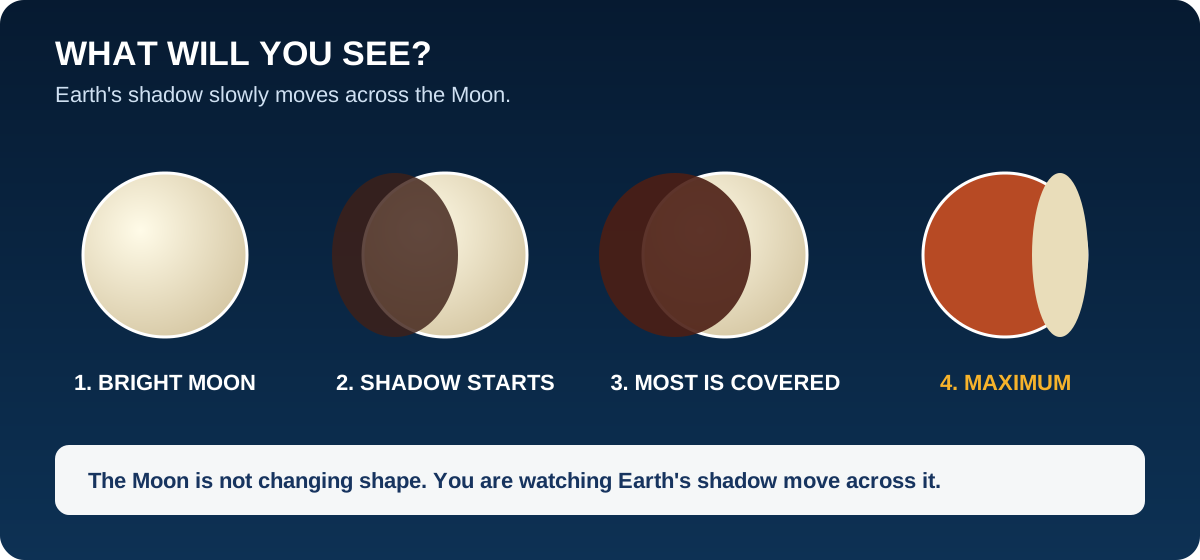 The Moon does not change shape. The dark area grows because the Moon is moving through Earth's shadow.
Then the process reverses. The Moon continues moving along its orbit, leaves Earth's shadow and becomes fully bright again.
The Moon itself has not changed shape. The changing dark area is Earth's shadow.
The change is slow enough to follow
An eclipse is not like a light being switched off. The Moon moves continuously through its orbit, so Earth's shadow appears to creep across the lunar surface. If you look only once, you see one stage. If you return several times, you can compare the shape and position of the shadow and actually observe the movement.
That slow progression is one of the best parts of watching. You are seeing evidence that the Moon is moving through space even though, from the ground, it can sometimes seem almost still.
8 · WHY RED?
Why might the Moon look reddish, copper or brown?
Because some sunlight still reaches it. That light passes through Earth's atmosphere first, which can leave more red and orange light reaching the shadowed Moon.
If Earth blocks sunlight, you might expect the shadowed Moon to become completely black. But Earth's atmosphere changes the story.
Some sunlight passes through the atmosphere around the edge of Earth. Our atmosphere scatters much of the blue light, while more red and orange light is bent into Earth's shadow.
Some of that reddish light can reach the Moon. That is why the shadowed part can sometimes look red, orange, brown or copper.
A colour you already know
Think about sunset
The same atmosphere that can make a sunset look orange or red is helping send reddish light toward the eclipsed Moon. The colour may be different from one eclipse to another because Earth's atmosphere is always changing.
Earth's atmosphere can colour the light
Even when Earth blocks direct sunlight, some sunlight passes through the edge of Earth's atmosphere. Our atmosphere scatters shorter blue wavelengths more strongly and allows more red and orange light to continue through and bend into Earth's shadow.
That filtered light can give eclipsed parts of the Moon a copper, brown, orange or reddish appearance. It is related to the same reason sunsets can look red. The exact colour is not guaranteed to be identical every eclipse because Earth's atmosphere can contain different amounts of cloud, dust and particles.
9 · WHEN?
When was the eclipse visible from South Africa?
The obvious partial phase began at about 04:33 SAST and maximum occurred around 06:12 SAST. From eastern South Africa the Moon was already very low toward the western horizon near maximum.
The eclipse happens in the early morning of Friday, 28 August 2026. It does not suddenly appear at maximum; the Moon moves gradually through different parts of Earth's shadow.
1
About 03:23 SAST
Penumbral phase begins. The Moon enters Earth's lighter outer shadow. At first, the change can be so gentle that you may not notice it.
2
About 04:33 SAST
The partial eclipse becomes obvious. Earth's darker shadow reaches the Moon and a clear dark edge begins moving across it.
3
About 06:12 SAST
Maximum eclipse. The Moon is deepest inside Earth's shadow and most of it is covered, although a small part remains outside the darkest shadow.
But wait... if the Sun is rising, where do I look?
Look WEST — the side where the Sun normally sets. The Sun will be rising on the opposite side of the sky in the east, while the Moon is getting ready to set in the west.
So the Sun can be beginning to rise behind you while you watch Earth's shadow on the Moon in front of you. You are standing on Earth between them. That is the eclipse geometry happening around you.
Your exact view depends on where you are
South Africa is a large country. In the east, including KwaZulu-Natal, the Moon will be very low on the western horizon near maximum and will set soon afterwards. Farther west, the Moon stays above the horizon longer. A clear western view is therefore especially useful.
Think of the times as a journey, not one appointment
The most useful way to watch is to follow the event over time. The early penumbral stage is subtle, the partial stage is much easier to recognise, and maximum is the point when the Moon is deepest in the shadow for this event. You do not need to wait until maximum to begin looking.
Because this happens near dawn in South Africa, the Moon will also be getting lower toward the western horizon while the eastern sky becomes brighter. Local horizon, buildings, hills and weather can therefore affect how much of the later eclipse you personally see.
10 · HOW DO I WATCH?
Do I need anything special to watch it?
No. Your eyes are enough. The important thing is a clear view toward the western horizon, because that is where the Moon will be getting lower as morning approaches.
A lunar eclipse is safe to watch with your eyes. You are looking at the Moon, not directly at the Sun. The most useful thing is not expensive equipment — it is a clear view of the western sky.
W
Find the western horizon
Choose an open place where buildings, trees or hills do not block the Moon as it gets lower in the sky.
T
Start before maximum
Do not only look at 06:12. Watching earlier lets you actually see Earth's shadow grow across the Moon.
E
Your eyes are enough
Binoculars or a telescope can show more detail, but they are optional. You can enjoy the eclipse without them.
P
Photograph or draw the change
Take pictures or make simple sketches at different times. Comparing them makes the movement of the shadow easier to understand.
!
Know the safety difference
A lunar eclipse is safe to view normally. A solar eclipse is different because looking directly at the Sun requires proper solar eye protection.
C
Give your eyes time
Stay for a while. The eclipse changes slowly, and the most interesting part is noticing how the Moon looks different from one moment to the next.
What makes a good viewing place?
Choose somewhere with an open view toward the west and arrive early enough to identify the Moon before it becomes very low. A darker location can make the sky more pleasant to observe, but you do not need to travel to a professional observatory. Your garden, an open field or another safe location with a clear horizon may be enough.
Unlike a solar eclipse, ordinary lunar-eclipse viewing does not require eclipse glasses because you are looking at the Moon. Binoculars can make the boundary of the shadow more interesting, while a camera can help you compare different stages, but neither is necessary to understand or enjoy the event.
ONE MORE DIFFERENCE
Wait... is this the same as a solar eclipse?
Both eclipses involve the Sun, Earth and Moon, but the object in the middle changes. That one change tells you whose shadow you are seeing.
L
Lunar eclipse
Sun → Earth → Moon.
Earth is in the middle, so Earth's shadow falls on the Moon. This is the event South Africa will see on 28 August.
Viewing: safe with your eyes.
S
Solar eclipse
Sun → Moon → Earth.
The Moon is in the middle, so the Moon's shadow falls on Earth. From some places, the Sun can appear partly or fully covered.
Viewing: proper solar eye protection is required.
The easiest way to remember the difference
Lunar eclipse: look at the Moon — Earth's shadow is on it. Solar eclipse: look toward the Sun only with proper protection — the Moon is blocking it.
Ask one question: what is in the middle?
If Earth is in the middle, Earth's shadow can fall on the Moon: that is a lunar eclipse. If the Moon is in the middle, the Moon's shadow can fall on part of Earth: that is a solar eclipse. The same three objects are involved, but their order changes the event completely.
This also explains the different safety advice. During a lunar eclipse you watch the Moon. During a solar eclipse people may be looking toward the extremely bright Sun, which is why proper certified solar viewing protection is essential.
BE A YOUNG SCIENTIST
Can I actually test and observe this myself?
You can turn the eclipse into a simple science activity. You only need paper, a pencil and a safe place with a clear view of the Moon.
1
Draw the Moon when you begin
Make one simple circle and shade the part that already looks darker.
2
Draw it again later
After some time, make a second drawing. Has Earth's shadow covered more of the Moon?
3
Record the deepest view you see
Near maximum, draw the Moon again. Notice how much of the bright edge remains visible.
4
Write down the colours
Did the shadow look grey, brown, orange, red or copper? Different people may describe the colour differently.
What have you just done?
You used a real scientific process: observe, record, compare and ask why. Science often begins by noticing a change carefully and then trying to explain what caused it.
Turn your drawings into evidence
Add the time beside every drawing. Then place the drawings next to one another in time order. You should be able to see whether the dark region became larger, changed position or appeared a different colour. That turns a simple sketch into a record of change.
You can also write one prediction before watching: What do I think the Moon will look like later? Afterwards, compare your prediction with what you actually observed. Scientists do this constantly: make a prediction, gather evidence, compare the result and improve the explanation.
KEEP LEARNING
Why this article still matters after 28 August
The date belongs to one particular eclipse, but the science does not expire. Every lunar eclipse follows the same basic idea: Sun → Earth → Moon. Earth blocks direct sunlight and its shadow falls across the Moon.
So whether you are reading this before the event, while it is happening, or years afterwards, you can use the same explanation to understand the next lunar eclipse you hear about.
QUICK QUESTIONS
The questions people usually ask next
Is the dark shape really Earth's shadow?
Yes. During a lunar eclipse, the dark area crossing the Moon is the shadow made by Earth blocking sunlight.
Is the Moon disappearing?
No. The Moon is still there. It is simply receiving less direct sunlight while it passes through Earth's shadow.
Why is the eclipse only partial?
Because most, but not all, of the Moon enters Earth's darkest shadow.
Why doesn't this happen every full Moon?
The Moon's orbit is tilted, so most full Moons pass above or below Earth's shadow.
Can I safely look at it?
Yes. A lunar eclipse is safe to view with your eyes because you are looking at the Moon, not the Sun.
A few questions worth asking afterwards
Why did the Moon not disappear completely? Why was the shadow curved? Why did the event take so long? Why could people in some parts of the world see more of it than others? Each question leads back to the same bigger ideas: Earth is round, the Moon is orbiting Earth, sunlight travels through space and observers are standing on different parts of a rotating planet.
That is what makes an eclipse useful for learning. One event in the sky connects light, shadows, orbits, Earth's atmosphere, time zones, geography and the movement of our planet.
If someone asks you, “What is actually happening?” — remember these five things
You do not need to remember every astronomy word. These five ideas are enough to explain the event to someone else.
1
The Moon reflects sunlight
The Moon does not make its own visible light. It looks bright because sunlight reaches it and reflects back toward us.
2
Earth moves into the middle
During a lunar eclipse, the order is Sun → Earth → Moon.
3
Earth blocks some sunlight
That creates a huge shadow stretching away from Earth and into space.
4
The Moon moves through the shadow
As it enters the shadow, the Moon looks darker even though the Moon itself has not changed shape.
5
This eclipse is partial
On 28 August 2026, most — but not all — of the Moon enters Earth's darkest shadow.
SUN → EARTH → MOON = LUNAR ECLIPSE
The amazing part is not that the Moon becomes dark
The amazing part is understanding what that darkness actually is.
When you look up on 28 August, you will be looking at the Moon almost 384,000 kilometres away — and seeing the shadow of the planet you are standing on stretched across it.
You will be looking at Earth's own shadow in space.
🤔 Stay Curious
The next time you see a shadow, remember this
A shadow can be tiny enough to fit under your feet — or enormous enough to reach the Moon.That is the scale of the Solar System, explained simply.