RM
Ronnie Mbuqe
Author · ExplainItSimply
5 August 2026
11 minute read
English
 A finished mission with one final chapter
The rocket had no crew, almost no fuel and no one controlling it
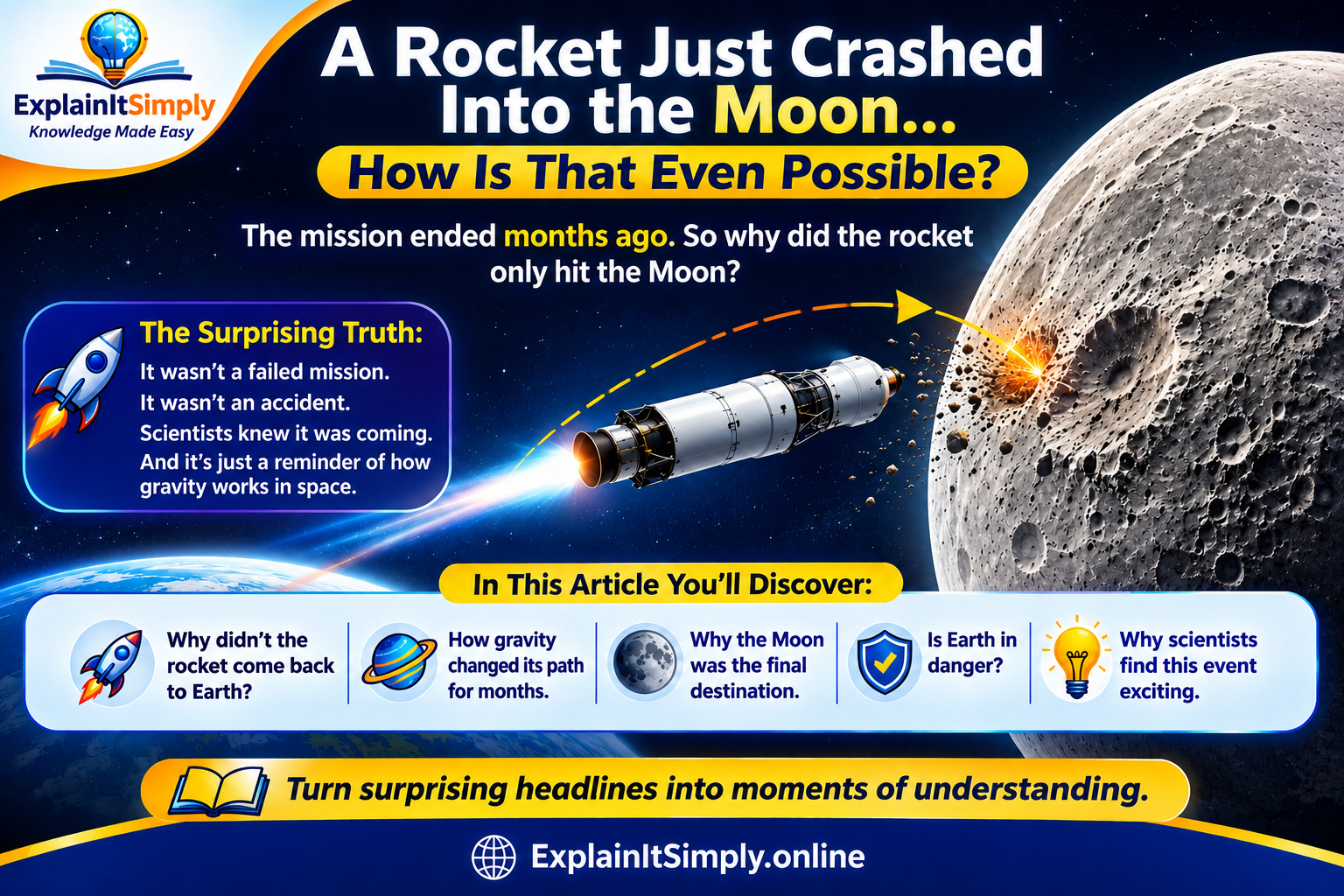
Yet after drifting through space for more than a year, the spent upper stage was predicted to strike the Moon at roughly 8,700 kilometres per hour. The real story is not only the collision. It is what happened after the rocket's job was already finished.
The headline behind the curiosity
Did a whole SpaceX rocket crash into the Moon?
No. It was not a complete rocket, and it was not carrying astronauts.
The object was the spent upper stage of a Falcon 9 rocket. It helped launch two lunar spacecraft in January 2025. After completing its part of the mission, the stage remained in space.
Tracking calculations predicted that it would hit the lunar surface near the Einstein crater region at about 06:35 UTC on 5 August 2026—08:35 in South Africa. Because the impact site was close to the Moon's edge as seen from Earth, immediate visual confirmation was difficult. Scientists must compare observations and later orbital images to identify the new crater.
The careful wording matters:
The impact was strongly predicted and is believed to have happened, but the final confirmation comes from observations—not simply because the clock passed the predicted time.
Think of a delivery vehicle
The rocket stage completed its job—but it did not disappear
Imagine a delivery truck taking a package to the edge of a long downhill road. The package continues toward its destination, but the empty truck is still physically somewhere.
A rocket works in stages. The lower stage provides the first enormous push. The upper stage then carries the spacecraft farther and faster. Once the payload separates, the upper stage may have little fuel left and no useful mission of its own.
Its job may be finished, but the object still has mass, speed and a path through space.
One of spaceflight's biggest surprises
A rocket does not need to keep its engine running to keep moving
On Earth, cars slow down because tyres rub against the road and air pushes against the vehicle. Space has almost no air and very little friction.
That means an object already moving through space can keep coasting for a very long time. The engine is used mainly to change speed or direction—not to hold the object up every second.
Everyday example
Imagine a shopping trolley on a perfectly smooth floor
Give it one push and remove almost all friction. It would continue rolling much farther than a trolley in a real supermarket. A rocket stage in space behaves in a similar way, although gravity continually bends its path.
The invisible traffic controller
If nobody steered it, what guided it to the Moon?
Gravity.
Earth pulled on it. The Moon pulled on it. The Sun pulled on it. Even sunlight can apply a tiny pressure over time. None of these effects needed to be dramatic on a single day.
Small changes accumulated across many months. Eventually, the stage's path and the Moon's path crossed at the same place and almost the same time.
Gravity did not suddenly grab the rocket.
It had been influencing the object during its entire journey. The collision was the final result of many small changes to its orbit.
The numbers sound unbelievable
Why was it travelling at about 8,700 km/h?
In ordinary life, 8,700 km/h sounds impossibly fast. In space, high speed is normal. Spacecraft need enormous speed to climb away from Earth and travel between worlds.
The stage was expected to strike at about 2.4 kilometres every second. At that speed, a four-tonne object carries enough energy to excavate a new crater and throw lunar dust above the surface.
Researchers estimated the crater could be tens of metres wide. Its precise size will depend on the impact angle, the stage's construction and the type of lunar ground it struck.
The question everyone asks
Was Earth—or the Moon—in danger?
Earth was not in danger. The collision happened roughly 384,000 kilometres away, and the impact was far too small to alter the Moon's orbit.
The Moon is also regularly struck by natural space rocks. Unlike Earth, it has almost no atmosphere to burn incoming objects before they reach the surface.
The concern is not that this single impact could damage the Moon. The larger question is what happens as more countries and companies send hardware into the space between Earth and the Moon.
Question 01How bright was the impact flash?
Question 02How high did the dust plume travel?
Question 03How large is the new crater?
Question 04Can orbiters locate the site precisely?
Question 05How accurately can we track objects near the Moon?
Question 06How should future missions dispose of old hardware?
The bigger story
The Moon is becoming part of the space-junk conversation
We usually hear about space debris around Earth: dead satellites, old rocket parts and fragments travelling at high speed.
But human activity is expanding toward the Moon. Future lunar orbiters, landers, communication satellites, scientific stations and perhaps permanent bases will share the same region.
An uncontrolled rocket stage hitting an empty area is not a disaster. An uncontrolled object crossing the path of an active spacecraft—or landing near equipment and people—would be a different matter.
This event therefore raises a simple but important question: When a mission ends, who is responsible for the hardware left behind?
Tiny facts · big ideas
Five facts hiding inside this story
- It was an upper stage, not an entire rocket. Rocket stages separate after completing different parts of the journey.
- Engines do not run continuously. Spacecraft can coast for months or years once they are moving.
- Gravity works everywhere. The path was shaped by Earth, the Moon, the Sun and other small forces.
- The Moon has almost no protective atmosphere. Incoming objects generally reach the surface instead of burning up.
- A predicted impact is not the same as immediate confirmation. Scientists still look for flashes, dust and before-and-after images of the crater site.
Explore the original science
Trusted external reading
These links open the research and tracking information behind the event.
- Scientific observing plan for the Falcon 9 lunar impact—how professional and amateur astronomers prepared to watch the predicted collision.
- Physical characterisation of object 2025-010D—research connecting the object to its launch and estimating the impact location and crater.
- Project Pluto tracking notes—the orbit calculations and plain-language updates used to follow the rocket stage.
- NASA Lunar Reconnaissance Orbiter—the spacecraft that maps the Moon in extraordinary detail and can help inspect impact sites.
The mission ended. The motion did not.
That is the part of the story a dramatic headline can easily miss.
The rocket stage did not suddenly wake up, lose control or decide to attack the Moon. It simply continued moving while gravity slowly rewrote its route.
In space, finishing your job does not mean finishing your journey.
🤔 The Next Time...
The next time you see a dramatic space headline
Pause before imagining the worst.What invisible journey happened before the final moment reached the news?