RM
Ronnie Mbuqe
Author · ExplainItSimply
30 July 2026
23 minute read
English
 The question behind the moment
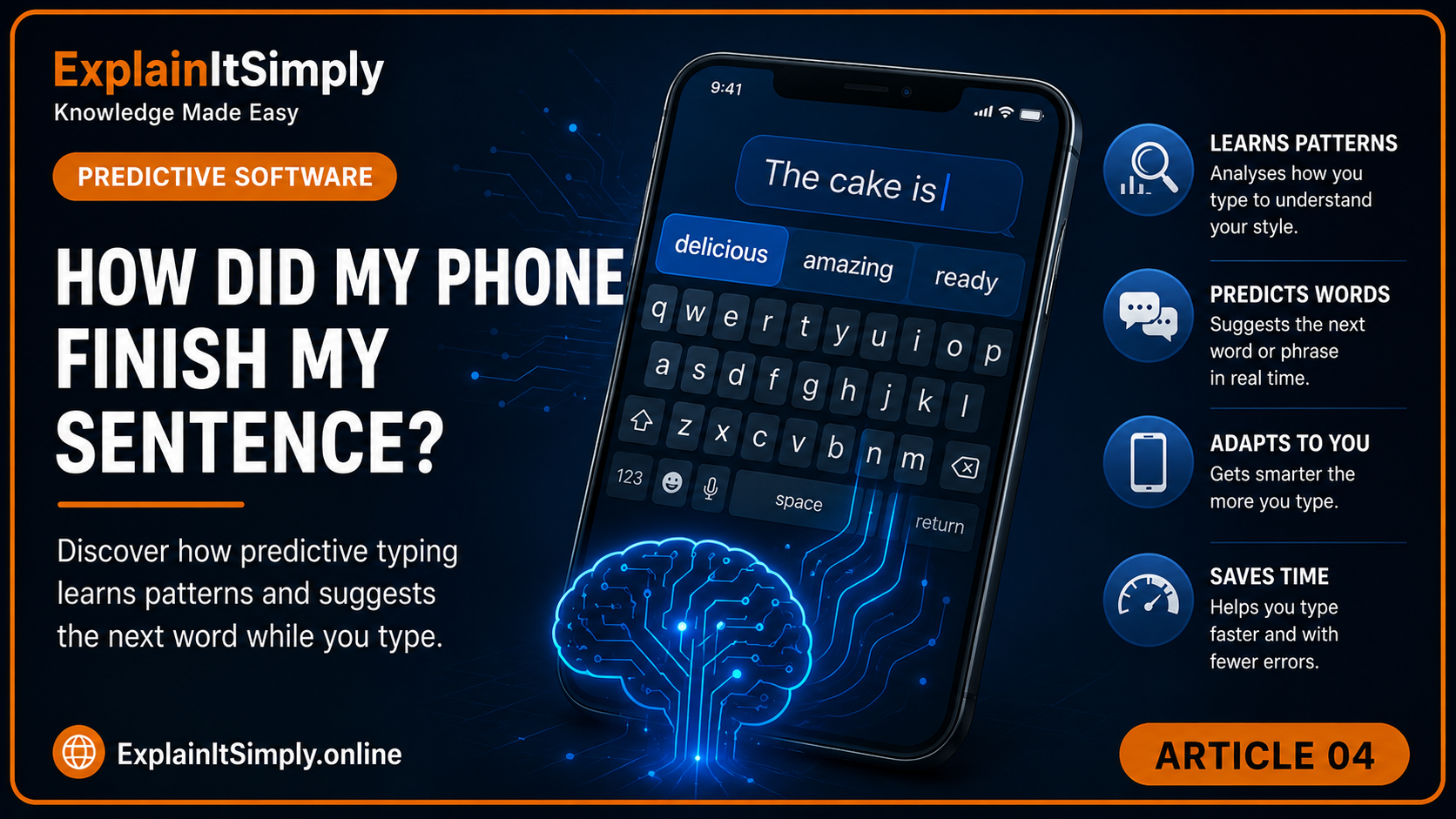
Your keyboard did not read your mind. It narrowed the possibilities using language, context and your taps.
We will follow the real journey, use familiar comparisons and connect every answer to the next question.
The sentence that seemed to write itselfYou type “I will be there in...” and your phone suggests “five minutes”
For a moment it feels as though the phone knows what you are thinking. It does not. It is estimating which word or phrase is likely to follow from the letters, nearby words, language patterns and sometimes your previous typing behaviour.
The suggestion feels personal because language is repetitive. We use familiar phrases, names and routines more often than we realise.
Real-life scene · Finishing a family sentenceThink of someone who knows your usual phrases
If you always say, “Please put the milk back in the...”, a family member may answer “fridge” before you finish. They did not read your mind. The beginning of the sentence strongly limited the likely ending.
Predictive typing does something similar at scale. It compares the current context with patterns learned from enormous amounts of language and, in some cases, your own saved preferences.
The first jobThe keyboard must understand what you may have intended to type
Touchscreen keys are small, fingers are imprecise and people type quickly. When you tap near the edge of a key, the keyboard considers nearby letters and possible words.
That is why typing “thw” may become “the”. The system combines the physical tap location with language probability.
Everyday comparisonHearing a sentence in a noisy room
If someone says “Please close the d, ” while a plate falls, you can still infer “door” from the situation. The keyboard also uses context to recover from imperfect signals.
Follow the predictionHow does the next word appear?
1You tap letters
The keyboard records approximate touch positions and the sequence of characters.
2Possible words are generated
It considers words that could match the taps, including common typing errors.
3The sentence provides context
Words before the cursor make some candidates more likely than others.
4Candidates are ranked
The keyboard displays the highest-probability suggestions.
5Your choice can influence future suggestions
Accepting or repeatedly typing names and phrases may help the keyboard adapt.
Does predictive text send everything you type somewhere else?
The exact behaviour depends on the keyboard and its settings. Some processing can happen on the device; some features may use cloud services; personalisation and diagnostic sharing may have separate controls.
The important lesson is to treat a keyboard as software with permissions and privacy settings, not as a passive sheet of letters. Password fields and sensitive inputs are often handled differently, but users should still choose trusted keyboard software.
Why the suggestion can be ridiculousThe keyboard predicts what is likely, not what you truly mean
It cannot see the complete thought in your head. A rare surname, an isiXhosa phrase, a private joke or a sudden topic change may not fit its strongest patterns.
That is why predictive text can save ten seconds and then spend the next minute trying to turn your friend's name into a household appliance.
More than spellingThe same letters can produce different suggestions because context changes everything
Type “I am going to the…” and the keyboard may suggest shop: office or airport. Type “Please switch off the…” and a completely different group becomes likely. The system is not only checking whether a word is spelled correctly. It is estimating which word commonly follows the words already present.
This is similar to completing a familiar song lyric. You do not examine every possible word in the language. The earlier words narrow the possibilities. Predictive typing performs a much faster statistical version of that narrowing.
Conversation comparisonA friend can finish your sentence because they know the situation
At a restaurant, “Please pass the…” may lead to salt. At a construction site, the likely ending changes. Meaning comes from the surrounding situation, not from the unfinished phrase alone.
Why strange suggestions happenThe keyboard is balancing several imperfect clues
Your finger may land between letters. The word may be uncommon. You may be mixing languages, typing a surname or using a local expression. The keyboard must decide whether to preserve what you entered, correct it or suggest something else.
Sometimes the statistically common word is completely wrong for your personal sentence. That is why autocorrect can transform an innocent message into accidental comedy. The system chooses what is likely in general or likely for your learned pattern; it does not fully understand your intention.
👆
Touch position
Which nearby key was your finger probably aiming for?
📖
Dictionary
Which valid words resemble the letters entered?
🧩
Sentence context
Which option makes sense after the earlier words?
👤
Your habits
Which names, phrases or languages do you choose repeatedly?
Why does predictive typing struggle when you switch between English and isiXhosa?
Languages have different word patterns, spelling rules and sentence structures. When a person moves naturally between languages, the keyboard first has to identify which language is being used. A short phrase may not provide enough evidence, especially when names and shared words appear in both.
Better multilingual systems learn from more representative writing and allow several language dictionaries to remain active. Even then, local slang, family names and newly invented expressions can confuse the model because real language changes faster than dictionaries.
AIStep back to the bigger ideaWhy is prediction one of the most common jobs performed by AI?Connect keyboard suggestions to cameras, banking, maps and recommendations.→
What should you remember?
- The keyboard combines touch position, spelling possibilities and sentence context.
- It ranks likely words; it does not read thoughts.
- Repeated choices can make suggestions feel more personal.
- Privacy depends on the keyboard, device and enabled settings.
Keep exploringOne answer opens another door
The system you have just followed depends on other systems. Choose the next hidden story.
The next time...
The next time your phone finishes a sentence correctly, remember that it did not enter your mind. It narrowed thousands of possibilities until one familiar phrase rose to the top.
Ordinary moment. Extraordinary story.
One more question before you goYour phone can recognise your writing patterns. How does it recognise your face?
Predictive typing compares language patterns. Face recognition compares measurements from a live scan with a protected facial template.
◉Continue the curiosity journeyHow Did My Phone Recognise My Face?Follow the journey from the camera's first scan to the final unlock decision.→
🤔 The Next Time...
The next time your keyboard finishes the sentence
The suggested word may feel as though the phone read your mind, but it actually compared language patterns and context.What clues in your unfinished sentence made that word the most likely next choice?