
RM
Ronnie Mbuqe
Author · ExplainItSimply
September 2026
18 minute read
English
The direct answer
What are the four seasons?
The four seasons are spring, summer, autumn and winter. They divide the year into periods with different amounts of daylight, warmth and typical weather.
They happen because Earth leans slightly to one side while completing its journey around the Sun. As Earth moves, different halves of our planet receive more direct sunlight at different times of the year.
The whole answer in one minute
Earth takes about one year to travel around the Sun. During that entire journey, Earth keeps the same gentle lean. For part of the year, the Southern Hemisphere, where South Africa is, leans more towards the Sun. Our sunlight is more direct, our days are longer and we experience summer.
About six months later, the Southern Hemisphere leans more away from the Sun. Sunlight reaches us less directly, our days are shorter and we experience winter. Spring and autumn are the gradual changes between those two conditions.
Why can South Africa have summer while Europe has winter?
Tilt changes the angle and duration of sunlight through the year.
Trace the explanation
Opposite hemispheres lean differently relative to the Sun at the same time. Distance from the Sun cannot explain opposite seasons occurring simultaneously.
Source and further reading: spaceplace.nasa.gov
Meet the seasons
How does the same plant change through the year?
A plant is a useful way to notice a season, because changes in daylight, temperature and rainfall affect how it grows. The pictures below follow the same tree through one year. They show a common pattern, but not every South African plant changes in exactly the same way.
!
A season is more than the appearance of one tree
Some trees lose their leaves; others do not. Some places receive winter rain; others receive summer rain. The seasons are defined by Earth’s relationship with the Sun, while local weather and plant life show the result differently.
What causes the seasons?
Consider a spinning ball leaning slightly to one side while it travels in a large circle around a lamp. The ball represents Earth, and the lamp represents the Sun.
Earth spins once roughly every 24 hours, giving us day and night. At the same time, it travels around the Sun, completing one orbit in about 365¼ days. Earth’s axis, the invisible line through the North and South Poles, leans by about 23.5 degrees.
That lean keeps pointing in almost the same direction as Earth travels. Earth does not rock backwards and forwards every few months. The changing seasons happen because our leaning planet moves to a different part of its path around the Sun.
Spring
Sep–Nov
Summer
Dec–Feb
Autumn
Mar–May
Winter
Jun–Aug
What does “more direct sunlight” mean?
The same amount of sunlight can produce different warming depending on the angle at which it reaches the ground.
Direct summer sunlight
When sunlight reaches the ground from higher in the sky, its energy is concentrated over a smaller area. The Sun also remains above the horizon for longer, giving the ground more time to warm.
Slanted winter sunlight
When sunlight arrives from lower in the sky, the same energy spreads across a larger area and passes through more atmosphere. The shorter day provides less warming time.
Try this comparisonShine a torch straight down, then tilt it
A torch held straight above a table makes a smaller, brighter patch. Tilt it and the light spreads into a larger, dimmer patch. The torch has not become weaker; its light is simply spread across more space. Sunlight behaves in a similar way.
Season 1
What happens during spring?
Spring is the transition from winter to summer. In South Africa, we commonly call September, October and November the spring months. The Sun appears higher in the sky, daylight lasts longer and temperatures generally begin rising.
Plants respond to the changing light, warmth and available water. New leaves and flowers may appear, insects become more active and many animals enter important feeding or breeding periods.
Spring does not begin because something suddenly changes on 1 September. South Africa uses 1 September as a familiar Spring Day, but the increase in daylight and warmth has already been developing gradually. The astronomical spring equinox normally occurs around 22 or 23 September.
Season 2
What happens during summer?
Summer is the warmest part of the year. South Africa commonly groups December, January and February as summer. During this period, the Southern Hemisphere is leaning more towards the Sun.
The sunlight is more direct, the Sun follows a higher path across the sky and daylight lasts longer. These conditions allow the land and air to gain more heat. Around 21 or 22 December, the Southern Hemisphere reaches its summer solstice, the longest day and shortest night of the year.
Much of South Africa receives most of its rain during the warmer months, often through afternoon thunderstorms. The Western Cape is an important exception because it has a Mediterranean-type climate and receives more of its rain during winter.
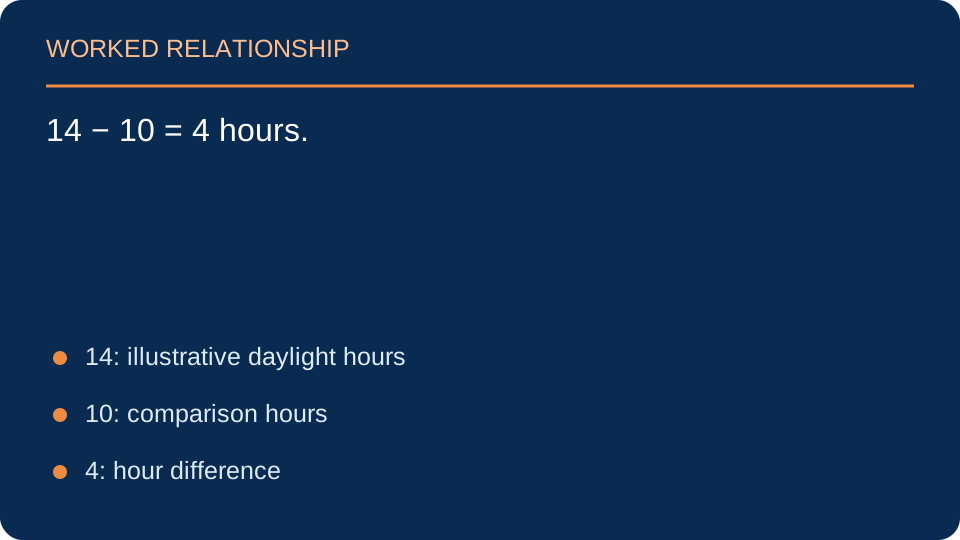
A toy daylight comparison has 14 hours in one season and 10 in another. What is the difference in hours?
Trace the explanation
14 − 10 = 4 hours. These are illustrative values, not a local daylight forecast. Latitude and date determine actual durations.
Source and further reading: spaceplace.nasa.gov
Season 3
What happens during autumn?
Autumn is the transition from summer to winter. In South Africa, March, April and May are commonly described as the autumn months. Daylight becomes shorter, the Sun follows a lower path and temperatures begin cooling.
Some plants slow their growth. Certain trees break down the green colour in their leaves, revealing yellow, orange or red colours before the leaves fall. Dropping leaves can help a tree reduce water loss and survive a colder or drier period.
South African autumn does not look the same everywhere. Coastal areas may remain mild, evergreen indigenous plants can stay green, and warmer northern areas may show less dramatic leaf colour than colder inland locations.
Season 4
What happens during winter?
Winter is the coolest part of the year. South Africa commonly groups June, July and August as winter. The Southern Hemisphere is leaning more away from the Sun, so our sunlight is less direct and our daylight hours are shorter.
Around 20 or 21 June, we reach the winter solstice, the shortest day and longest night of the year in the Southern Hemisphere. After that day, daylight slowly begins increasing again, even though the coldest weather may still arrive later because land, air and oceans take time to warm.
Winter does not automatically mean snow. Many South African places experience dry, sunny winter days and cold nights. Snow is mostly limited to high mountain areas and occasional cold events in suitable regions.
Two halves of one planet
Why is South Africa’s summer America’s or Europe’s winter?
Earth is divided into two halves by the equator: the Northern Hemisphere and the Southern Hemisphere. When the Southern Hemisphere leans more towards the Sun, the Northern Hemisphere leans more away from it.
That is why South Africa can enjoy summer in December while countries such as the United Kingdom, Canada and much of the United States experience winter. Six months later, the situation is reversed.
Places close to the equator receive relatively direct sunlight throughout the year. Their year may be described more clearly by wet and dry seasons than by four strongly different temperature seasons.
A common misunderstanding
Are seasons caused by Earth moving closer to the Sun?
No. Earth’s path is not a perfect circle, so its distance from the Sun changes slightly. But that distance change does not cause summer and winter.
The strongest proof is simple: both hemispheres are almost the same distance from the Sun at any moment, yet they experience opposite seasons. When South Africa has summer, the Northern Hemisphere has winter.
In fact, Earth is usually closest to the Sun in early January, during Southern Hemisphere summer but Northern Hemisphere winter. The angle of sunlight and the length of the day are the main causes of our seasons.
Two useful calendars
When does each season officially begin?
You may hear two different answers because people use two systems.
1
Meteorological seasons
These use complete calendar months. In South Africa: spring begins 1 September, summer 1 December, autumn 1 March and winter 1 June. This system makes weather records easier to compare.
2
Astronomical seasons
These are based on equinoxes and solstices. Their dates usually fall near 20–23 March, 20–22 June, 22–23 September and 21–22 December.
A closer lookOpposite hemispheres test the distance explanation
When southern Africa has summer, much of the Northern Hemisphere has winter. Both hemispheres are on the same planet at essentially the same Sun-Earth distance.
Work through the distinction
Axial tilt changes sunlight angle and day length differently in the two hemispheres. A schematic should keep the axis direction consistent as Earth moves around the Sun.
What explains the opposite seasonal pattern?
Choose an answer to see feedback. You can try again.
Show the answer and explanation
Axial tilt and changing illumination. Axial tilt changes sunlight angle and day length differently in the two hemispheres. A schematic should keep the axis direction consistent as Earth moves around the Sun.
Neither system changes what Earth is doing. They are simply two ways of placing names and dates around a gradual, continuous journey.
How would you arrange a lamp and tilted globe to show opposite seasons without moving the lamp?
One reasoned response
Keep the axis pointing approximately the same direction as the globe travels around the lamp. Compare the hemispheres' lighting rather than tilting the globe toward the lamp at every position.
Source and further reading: spaceplace.nasa.gov
What should you remember?
- The four seasons are spring, summer, autumn and winter.
- Earth leans slightly to one side while travelling around the Sun.
- Earth keeps that lean pointing in almost the same direction throughout the year.
- Summer brings more direct sunlight and longer days.
- Winter brings less direct sunlight and shorter days.
- Spring and autumn are the gradual transitions between summer and winter.
- South Africa’s seasons are opposite to those in the Northern Hemisphere.
- Earth’s changing distance from the Sun is not the cause of the seasons.
Frequently asked questions
A few useful questions the seasons
Does Earth suddenly change on Spring Day?
No. Daylight and temperature change gradually. Spring Day is a useful calendar marker for a change that has been developing over time.
Does Earth lean closer to the Sun in summer?
Our hemisphere leans more towards the Sun, but the important effects are more direct sunlight and longer daylight, not a meaningful reduction in the distance between us and the Sun.
Why can it still be cold during spring?
A season describes a general pattern over several months. Individual cold fronts, winds, clouds and rain can still produce cold days during spring or cooler days during summer.
Why is the hottest day not always the longest day?
Land, oceans and air store heat and take time to warm. Temperatures often continue rising after the summer solstice even though the daylight has begun shortening very slowly.
Do all countries have four clear seasons?
No. Areas near the equator may have wet and dry seasons, while polar regions experience extreme changes in daylight. Local geography and climate affect how strongly each season is felt.
Do all trees lose their leaves in autumn?
No. Deciduous trees lose their leaves, but evergreen plants keep leaves throughout the year. South Africa has many evergreen indigenous species.
The next time you notice a season changing...
Look at the length of the day, the position of the Sun, the temperature and the plants around you. You are not watching Earth suddenly enter a new room in space.
You are noticing the slow result of a leaning planet continuing its journey around the Sun.
Four seasons. One orbit. A change we can see from the ground.