RM
Ronnie Mbuqe
Author · ExplainItSimply
October 2026
13 minute read
English
A star can change before its news reaches your eyes
Look up at a star and the light entering your eye began its journey earlier. The delay can be years, centuries or longer, depending on the distance. Astronomy is built from arriving messages, not an instant view across the whole sky.
That makes an intriguing statement possible: a distant star might have ended a stage of its life while earlier light is still travelling towards us. But “might” matters. The light's age does not, by itself, tell us that a particular star has died.
Most importantly, this is not a reason to claim that all the familiar stars overhead are ghosts. A star's lifetime and evolutionary state must be considered alongside its distance. The accurate story is more interesting than an exaggerated slogan because it explains what we can and cannot know.
A light-year sounds like time. It measures distance.
A light-year is the distance light travels in one year. For a simple nearby-space example, a star 100 light-years away sends us light that has travelled for about 100 years. Distance and travel time are connected by light's finite speed.
Imagine a messenger who takes a century to arrive. An accurate report describes conditions at departure; it cannot automatically describe everything that happened afterwards. Light behaves differently from a person carrying a letter, but the analogy makes the information delay visible.
Even nearby objects are seen with a delay. Sunlight takes about eight minutes and twenty seconds to reach Earth on average. The delay becomes more noticeable when the distances are enormous, not because distant light has to slow down.
If the event happened fifty years ago, why might we still see the earlier star?
Use a fictional star held at a fixed distance of 100 light-years. Suppose an event at the star occurred fifty years ago in our simplified shared time coordinates. Its new signal has travelled fifty light-years and still has fifty to go before reaching Earth.
The light arriving today left the star about a hundred years ago, before the event. Nothing has to keep an image hanging in space, and the light does not need the original source to continue existing. Previously emitted light keeps travelling until it interacts with something.
The calculator uses a fixed-distance, non-expanding teaching model. It does not identify an actual dead star, predict a supernova or settle the subtleties of defining distant events as simultaneous. For very distant galaxies, cosmic expansion makes the relationship between distance and lookback time more complicated.
An imaginary observer and a delayed signalA hundred-year journey makes a fifty-year-old event invisible for now
Use the fictional star in the calculator and keep it fixed 100 light-years away. Give the simplified model a shared time coordinate. Earlier light leaves the star, an event occurs later, and each signal travels towards Earth at light speed.
Suppose the event occurred fifty years ago in that coordinate system. The event signal has completed fifty years of its hundred-year journey. The observer at Earth still receives light emitted before that event. The missing news is not being hidden by a weak telescope; it has not reached the observer.
Now change the event to 150 years ago while keeping the same distance. Its signal would have arrived fifty years ago in this model. The situation is no longer one in which the event's first signal remains on its way. Comparing the two intervals, rather than using distance alone, determines the answer.
These are invented numbers for a fixed-distance example. They are not an announcement that a known star has exploded, and they are not a method for predicting stellar deaths. The exercise isolates how information delay works.
Three distances can produce three different views of the same kind of event
All examples suppose an event fifty years ago in the model's shared time coordinate| Fixed distance | Signal travel time | What the model says today |
|---|
| 20 light-years | 20 years | Its first event signal arrived 30 years ago |
| 50 light-years | 50 years | Its first event signal is arriving now |
| 100 light-years | 100 years | Its first event signal needs 50 more years |
Notice that the event's age stayed the same. Only the distance changed. That is why “it happened fifty years ago” does not tell a distant observer whether the news should already be visible.
The table is also a check on the calculator. Use its three rows as predictions before entering the values. If you can explain each result using the remaining journey, you understand more than a slogan about looking into the past.
Real measurements include uncertainty, and very distant cosmological observations require a more sophisticated account of distance and time. The table should not be extended to every galaxy by treating the Universe as a stationary classroom.
Why does “the light is old” not prove “the star is dead”?
Many stars live for far longer than the light-travel times separating them from us. Massive stars generally use their fuel more rapidly and have shorter lives than less massive stars. The relevant comparison is between travel delay and the star's remaining evolution, not between travel delay and a human lifetime.
A fictional star whose light takes a few hundred years to reach us may have a very long future ahead. Another object seen in a brief, unstable late stage presents a different question. Astronomers use observations and stellar models to assess those situations; the number of light-years alone is insufficient.
“Death” also compresses several physical outcomes into a dramatic word. Sun-like stars can leave white dwarfs, while more massive stars can have very different endings. A stellar remnant can still emit light, so “dead” does not necessarily mean invisible.
What does it mean for a star to “die” if something still shines?
In everyday language, death can suggest an object simply vanishing. Stellar evolution is more varied. A star can leave a hot remnant and surrounding material that remain observable after its earlier long-lived stage has ended.
For a Sun-like star, a white dwarf is a compact remnant with a very different source of ongoing luminosity from the star's earlier core hydrogen fusion. More massive stars can have other outcomes, including remnants associated with supernova explosions. The physical details depend on the star and its history.
Therefore “we are seeing a dead star” can mean two different things: seeing old light emitted before an ending whose signal has not arrived, or directly observing a stellar remnant after evidence of the transition has reached us. Those descriptions should not be swapped.
Ask what object and stage a report is actually describing. A photograph of glowing material around a remnant is evidence of a later state being observed, not automatically a picture of a normal star whose death remains unknown to us.
Can a stronger telescope catch up with a newer picture?
A bigger telescope can collect more light and, depending on its design, reveal finer detail. It cannot collect light that has not arrived. Increasing magnification does not shorten the journey between the source and the instrument.
That limitation is also an extraordinary opportunity. Looking farther away lets astronomers study earlier stages of cosmic history. Different objects arrive in our data at different lookback times, providing evidence about how stars and galaxies evolve.
A telescope is not travelling backward in time or sending a message to the past. It is receiving older signals in the present. Keeping the receiving event separate from the emitting event removes much of the apparent mystery.
How can astronomers know anything about a star they cannot visit?
Light carries measurable structure, not only a brightness that makes a dot visible. A spectrum separates arriving light by wavelength. Patterns in that spectrum can help scientists investigate temperature, composition and motion when interpreted with suitable physical models.
Observations over time add another dimension. A changing brightness can have several explanations, including an object's own behaviour, something passing in front of it or an observational effect. Scientists test alternatives instead of assigning a cause from one dramatic frame.
Different wavelengths can reveal different processes or regions. A visible-light image and an infrared image need not show the same features, even when they concern the same object. The instruments are measuring different parts of the arriving radiation.
All of that evidence still comes with the travel delay. A detailed measurement improves what we know about the source at the relevant emission time; it does not magically remove the interval before the signal arrived.
Why can a bigger telescope see older light without making the light older?
A larger light-collecting area can gather more of a faint arriving signal. Appropriate instruments can also resolve details or measure wavelengths unavailable to the naked eye. That helps observations of objects too faint or small-looking to examine unaided.
The instrument does not age the photons or slow their journey. It makes a measurement possible when the available signal is weak. Looking at a more distant object means receiving light with a longer history of travel under the relevant model.
There is also no contradiction in saying the observation happens now while the emission happened earlier. They are different events at different places. Your eye or telescope is the endpoint of a journey that began elsewhere.
That distinction is worth carrying into headlines. “Discovered this year” usually describes when people detected or identified the signal, not a guarantee that the physical event occurred near Earth during this calendar year. The sky is a collection of arriving histories, with evidence needed for each one.
What would count as news that the star changed?
New light and other arriving signals can reveal an event. Scientists compare observations across time and wavelength, looking for changes that support a physical explanation. The interpretation depends on measurements, rather than a caption attached to a dramatic photograph.
When you read about a supernova discovered this year, distinguish the year its signal was detected from the earlier event at its source. Both dates describe something meaningful, but they are not the same part of the story. A headline often uses the date of discovery because that is when the event became available to us.
The next time a star catches your attention, ask two questions: how far has this light travelled, and what do observations tell us about the object that emitted it? That is a stronger curiosity than assuming the sky is already empty.
Sources and further reading
A closer lookOld light does not prove a dead star
A nearby-space example places a star 100 light-years away. If it changed 20 years ago, that change's light has not yet reached us under this simplified setup.
Work through the distinction
The light we receive is delayed information. It does not tell us by itself that the star has changed, and a larger telescope cannot remove the light's travel time.
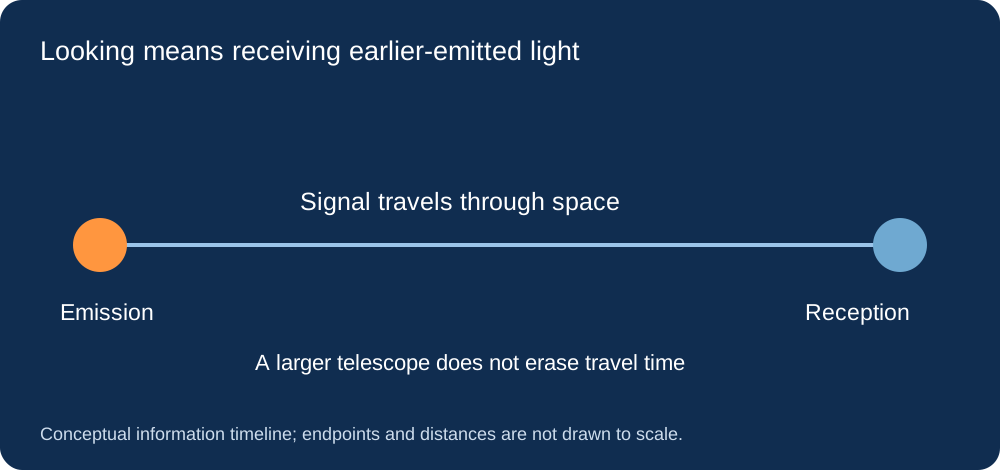
Would we already see that twenty-year-old change?
Choose an answer to see feedback. You can try again.
Show the answer and explanation
No. The light we receive is delayed information. It does not tell us by itself that the star has changed, and a larger telescope cannot remove the light's travel time.