RM
Ronnie Mbuqe
Author · ExplainItSimply
30 July 2026
28 minute read
English
 The question behind the moment
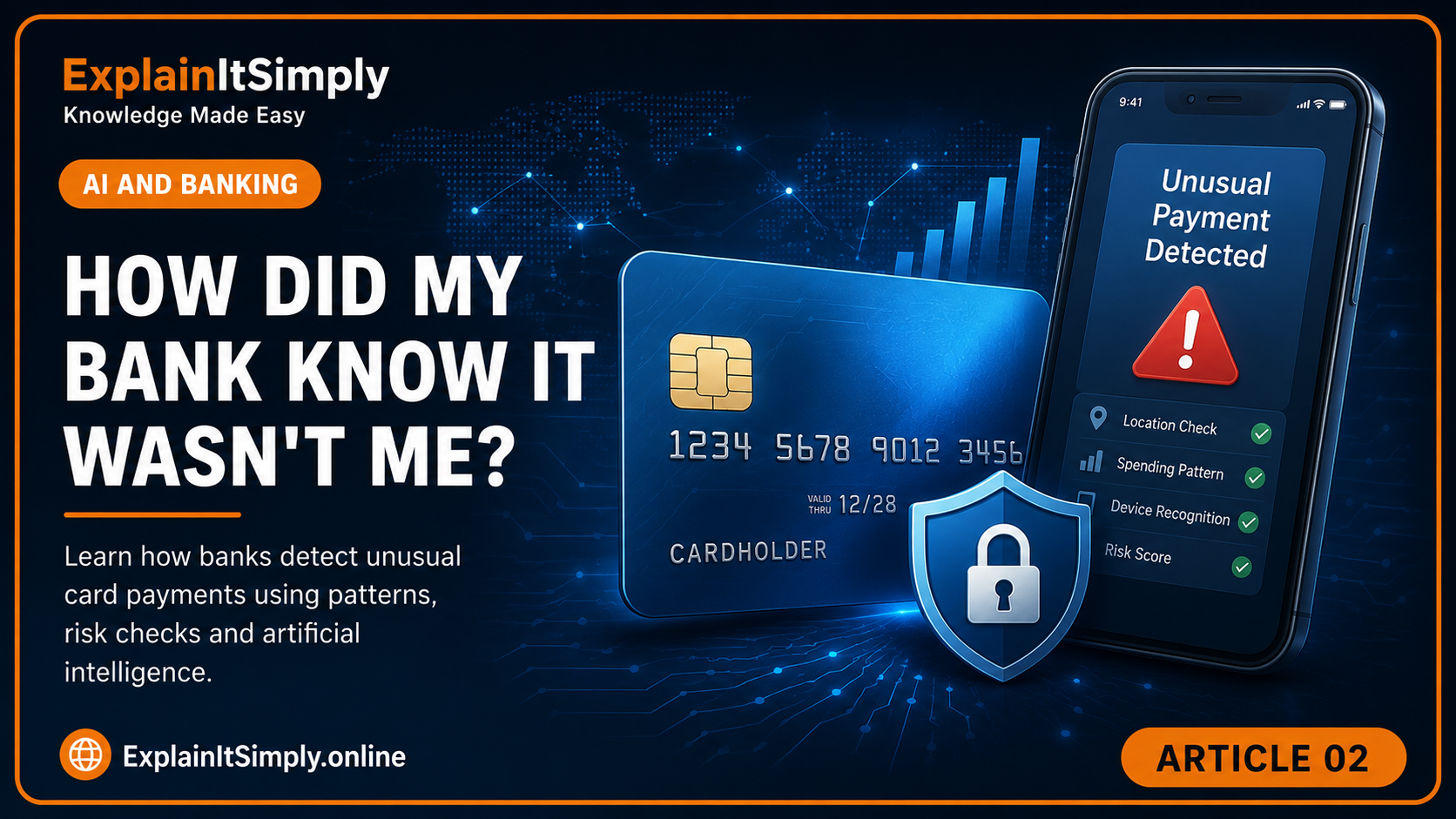
A payment happens in seconds. Behind it, your bank may have checked a surprisingly long list of clues.
We will follow the real journey, use familiar comparisons and connect every answer to the next question.
The unexpected alertYour card was declined, and the bank may have protected you
At 02:17, a payment request arrives for an expensive electronic item in a place you have never visited. Your normal pattern is groceries, fuel and an occasional takeaway near home.
The bank has only a moment to choose: approve, decline or ask for more proof. It does not know the complete story. It sees clues.
Real-life scene · One unusual purchaseConsider a security guard who knows the normal rhythm
A good guard does not stop every person. The guard notices combinations: an unfamiliar person, an unusual hour, a forced door and behaviour that does not match the environment.
Bank fraud systems work similarly. A large amount alone may be legitimate. A foreign location alone may be legitimate. But several unusual clues arriving together can raise the risk.
When protection becomes inconvenientWhy can the bank block a payment that really was yours?
The bank is balancing two costly mistakes. Approving fraud can lose money and expose a customer. Blocking a genuine purchase can embarrass and frustrate the customer.
The system therefore uses thresholds. A low-risk payment may pass immediately. A medium-risk payment may trigger an OTP. A very high-risk payment may be declined.
This is not proof that the bank “knows” who is holding the card. It is a risk decision made from limited evidence.
Follow the money requestWhat actually happens after you tap your card?
You see a beep and wait for the word Approved. Behind that moment, the payment terminal packages the amount, merchant, time and card details into a secure request. That request travels to the merchant's payment provider, through the card network and toward the bank that issued your card.
The bank checks whether the card is valid, whether enough funds or credit are available, whether the transaction breaks a rule and whether the behaviour resembles previous activity. The response then travels all the way back. The shop does not directly take money from your account at the moment of the beep; it receives permission to continue with the payment process.
1The shop asks
“May this card pay this amount at this merchant now?”
2The network routes the request
The request moves through payment systems to the correct issuing bank.
3The bank evaluates risk and funds
Rules and models look for unusual combinations while the account balance or credit limit is checked.
4An answer returns
Approved, declined or request more verification.
One unusual clue may be harmless; several together may change the decision
Buying petrol in Cape Town after buying groceries nearby is ordinary. Buying an expensive television in another country five minutes later may be impossible according to distance and time. A large amount is not automatically fraud, and a foreign purchase is not automatically fraud. The concern often comes from the combination.
📍
Location
Is the purchase near the customer's usual area, or did the card appear to travel impossibly fast?
🕒
Timing
Is the purchase happening at a normal time, and how quickly did it follow another transaction?
💰
Amount
Is the amount normal for this account, this merchant and this type of purchase?
📱
Device and method
Is this a trusted phone and familiar payment method, or a new device attempting an unusual action?
The system does not see a person standing at a till: it sees a structured record
When the payment request reaches the bank, software turns it into fields that computers can compare. Think of it as one new row arriving in a very large table.
R
Amount
R2,450.00, together with the currency and whether the payment is a purchase, cash withdrawal or transfer.
▦
Merchant
The merchant identifier, business category, country and payment terminal or online gateway.
◷
Time
The exact date and time, plus how long it has been since the previous transaction.
⌖
Location
The country, city or terminal location, compared with recent transactions and known travel behaviour.
▣
Method and device
Chip, tap, magnetic stripe, online payment, saved card, mobile wallet, new browser or trusted banking device.
↻
Recent activity
Declines, repeated attempts, rapid purchases, balance checks and other events that happened moments earlier.
The important programming ideaSoftware cannot compare a vague feeling; it compares values
A person might say, “This payment feels strange.” A program needs that feeling translated into measurable questions: Is the amount five times larger than normal? Is the device new? Did the card appear in two distant places within ten minutes? Programming turns suspicion into data that can be tested.
The programming sideDevelopers first teach the system clear rules
Some fraud checks are ordinary programming rules written by software developers and risk specialists. A rule is an instruction that says: when a particular condition is true, add risk, request verification or stop the transaction.
A simplified example:riskScore = 0;
if (amount > customerAverageAmount * 5)
riskScore += 20;
if (isNewDevice)
riskScore += 15;
if (distanceFromLastPurchase > 1000 && minutesSinceLastPurchase < 30)
riskScore += 40;
if (failedAttemptsInLastTenMinutes >= 3)
riskScore += 30;
if (riskScore >= 60)
decision = "Decline or verify";
This is not the bank's real code. Real systems contain far more checks, safeguards and exceptions. But the principle is accurate: developers convert business knowledge into conditions the software can execute in milliseconds.
The rules also need context. A R20,000 purchase may be unusual for one account but completely normal for another. The programmer therefore does not simply write if amount is high, decline. The rule often compares the new amount with the customer's own history, the merchant type and other signals.
Turning raw data into useful cluesThe system creates new measurements called features
The raw transaction says “R2,450 at 02:17.” By itself, that is not enough. Software calculates additional values that make the pattern easier to recognise. In machine learning these calculated clues are often called features.
1Compare the amount
The system may calculate how many times larger this purchase is than the customer's usual purchase.
2Measure the distance
It can compare the current merchant location with the previous transaction and estimate whether the travel time is realistic.
3Count recent attempts
It may count how many payments, declines or password failures occurred during the last few minutes.
4Recognise familiarity
It checks whether this merchant, device, country or transaction method has appeared before.
5Measure deviation
It calculates how far the new behaviour sits from the customer's normal pattern and from known fraud patterns.
This is where databases and programming work together. The application receives the new transaction, queries recent history, performs calculations and passes a compact set of clues to the decision engine.
Where AI entersA machine-learning model looks for combinations too complex to write as individual rules
Rules are powerful, but criminals change behaviour. Developers cannot manually write every possible combination. Machine learning helps by studying large collections of past transactions that were later confirmed as genuine or fraudulent.
During training, the model is shown examples and learns which combinations often appear before fraud. It may discover that a new device is usually harmless, but a new device combined with a late-night purchase, rapid retries and a high-risk merchant is much more concerning.
A useful comparisonRules are the checklist; the model is the experienced investigator
A new security guard may follow a written checklist. An experienced investigator also notices combinations that are difficult to describe in one sentence. Banking systems often use both: explicit rules for known dangers and a model for subtler patterns.
The model does not normally return the sentence “This is definitely fraud.” It returns a probability or risk score. For example, the system may estimate that the transaction is much more similar to previous fraud than to the customer's usual behaviour.
Combining the evidenceMany small signals become one risk score
Consider the transaction begins at zero. Different parts of the system then contribute evidence.
+10
Unusual hour
The card is rarely used after midnight.
+20
New device
The online purchase comes from a browser the bank has not seen before.
+25
Large deviation
The amount is far above the customer's normal range.
+35
Impossible movement
A recent purchase happened too far away for the same person to reach this location in time.
The exact numbers and methods vary by institution. The point is that the decision is usually based on accumulated evidence instead of one dramatic clue.
Example decision bands:Low score: approve. Medium score: ask for an OTP or banking-app confirmation. High score: decline, freeze temporarily or send the transaction to a specialist system for further review.
All of this happens in real timeSeveral software components cooperate before the card machine finishes beeping
1Transaction service
Receives and validates the payment message.
2Database and data services
Retrieve recent behaviour, account status, trusted devices and known merchant information.
3Rules engine
Runs the programmed conditions for known risks, limits and regulatory requirements.
4AI scoring service
Evaluates the calculated features and returns a fraud probability or risk score.
5Decision engine
Combines funds, rules, model score and bank policy into approve, verify or decline.
6Response and audit
Sends the answer back and records why the decision was made so it can be reviewed later.
This is software architecture in action. Different programs have different jobs, but they exchange information through carefully designed messages and application programming interfaces. Speed matters, but reliability matters just as much: the system must not approve the same request twice, lose the audit trail or expose sensitive card data.
How the system improvesThe final truth may arrive hours or days later
At the moment of payment, the system only makes a prediction. Later, the customer may confirm “Yes, that was me” or report fraud. Investigators may also identify a compromised merchant or a group of linked transactions.
Those outcomes become feedback. Data teams use confirmed examples to test rules, retrain models and adjust thresholds. Developers then release updated software through controlled testing because a small change can affect millions of genuine payments.
This learning loop explains why fraud detection is not a single piece of AI. It is an entire system involving programmers, databases, cybersecurity specialists, data engineers, machine-learning models, operations teams and human investigators.
When protection interrupts youWhy can a genuine payment still be declined?
No detection system sees the full story. The bank may know that the transaction is unusual but not that you have just landed in another country, bought a new phone or decided to make a once-off expensive purchase. It must make a quick decision using incomplete information.
That creates a trade-off. If the bank is too relaxed, fraud passes through. If it is too strict, genuine customers are interrupted. Extra verification, such as an app approval, one-time PIN or call, is a way of asking for one more strong clue before deciding.
📍Another location mysteryHow does a map know where you are and where traffic is building?Follow GPS signals, moving phones and route predictions.→
What should you remember?
- A card payment is a request, not an automatic transfer.
- The bank evaluates several clues in a very short time.
- Fraud detection compares the new transaction with rules and patterns.
- An extra security step usually means the system needs more confidence.
Keep exploringOne answer opens another door
The system you have just followed depends on other systems. Choose the next hidden story.
The next time...
The next time your banking app asks, “Was this you?”, remember that the question may be the final step of a rapid investigation involving location, timing, merchant, amount, device and recent behaviour.
Ordinary moment. Extraordinary story.
One more question before you goIf location can help a bank detect fraud, how does your phone know where you are?
The same location clues that can protect a payment also help navigation services estimate movement, traffic and arrival times.
↗Continue the curiosity journeyHow Did Google Know There Was Traffic Before I Did?Follow the movement clues that reveal a traffic jam before it appears ahead of you.→
🤔 The Next Time...
The next time your bank pauses a payment
It may feel inconvenient, but a hidden risk system has just compared several clues in seconds.What did the system notice that did not fit your usual pattern?