RM
Ronnie Mbuqe
Author · ExplainItSimply
30 July 2026
24 minute read
English
 The question behind the moment
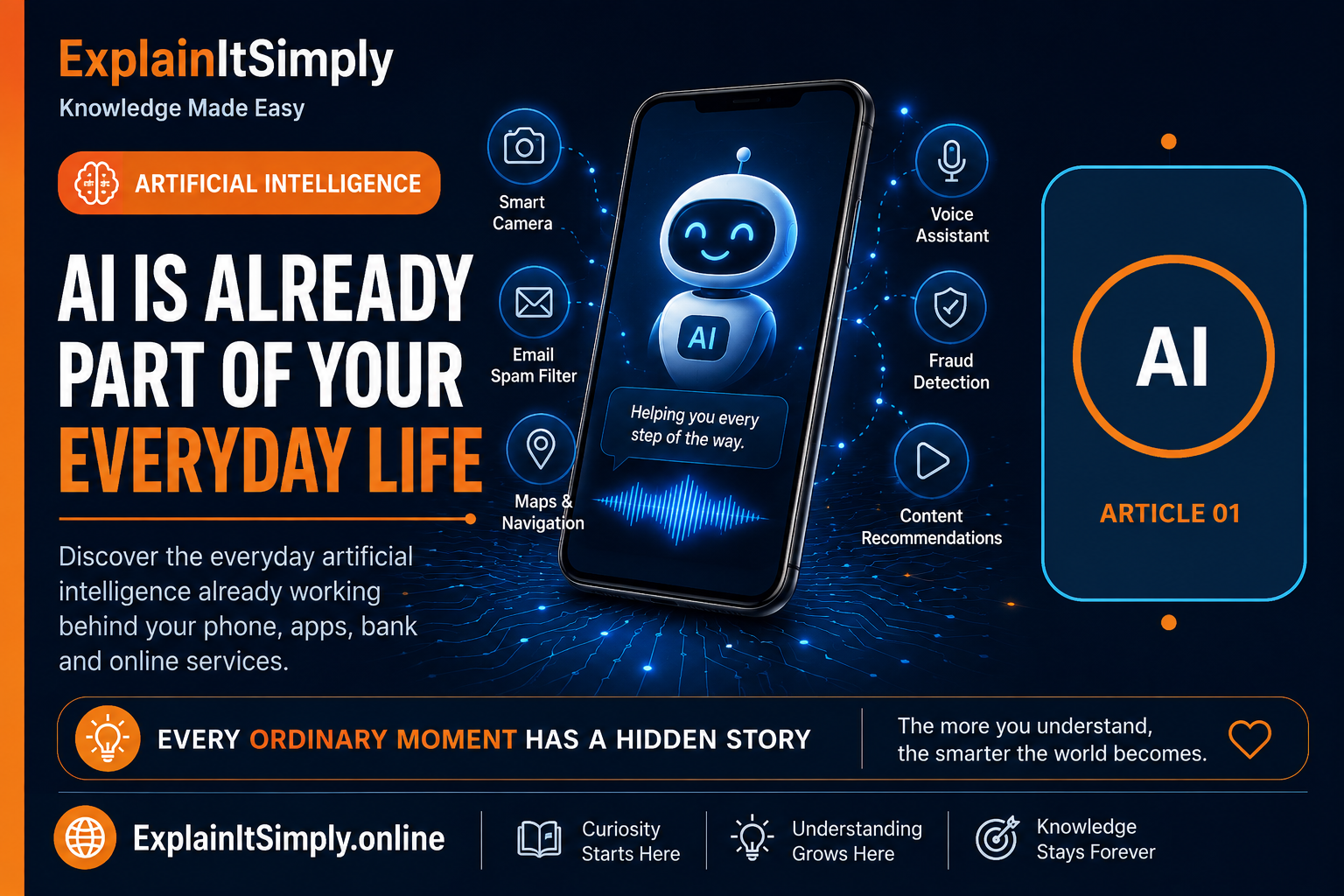
AI is not waiting in the future. It may already have helped you before breakfast.
We will follow the real journey, use familiar comparisons and connect every answer to the next question.
A morning full of invisible decisionsBefore breakfast, several machines may already have made decisions for you
Your alarm rings. Your phone unlocks when it sees your face. The weather app warns about rain. Your inbox hides suspicious messages. Your keyboard suggests the next word. A map quietly recommends another road.
None of these moments introduces itself with dramatic music and the words Artificial Intelligence has entered the room. The help appears as an ordinary result: unlocked, filtered, suggested, improved or warned.
That is why AI can feel mysterious. You see the final action, but not the examples, measurements, comparisons and probability scores that happened first.
Real-life scene · 06:10Follow one ordinary morning
You silence the alarm and look at your phone. Face recognition checks whether the face belongs to you. The camera improves the image because the bedroom is still dark. Your email app sorts overnight messages. A banking app may have checked unusual activity while you slept.
You have not opened an AI application. You have simply used a modern phone.
The important idea: AI is often not a separate destination. It is a small decision-making part inside a larger service.
A useful comparisonAI is closer to a chef than a crystal ball
A chef learns from many meals. The chef notices that certain ingredients, temperatures and timings usually produce certain results. When a new order arrives, the chef does not search the future. The chef uses learned patterns to decide what is likely to work.
Kitchen comparisonIngredients, recipe and judgement
Data is like the ingredients. Training is like years of learning recipes. The model is the chef's learned ability. The prediction is the meal the chef expects will satisfy the order.
A skilled chef can still misunderstand the order. In the same way, a powerful AI system can produce a confident result that is wrong.
Follow the journeyWhat happens between the signal and the action?
1Something arrives
An image, message, sound, location update or search request reaches the system.
2Useful features are measured
The system turns the input into numbers it can compare: shapes in a face, words in an email, movement on a road or patterns in spending.
3A probability is produced
Is this probably the phone owner? Is this message probably spam? Is this payment probably unusual?
4Software applies a rule
Unlock the phone, move the email, warn the driver or ask for another security check.
Five places AI may already be helping you
⌨
Predictive typing
Your keyboard estimates which word is likely to come next from language patterns and the context of the sentence.
✉
Spam filtering
Email systems compare wording, links, sender behaviour and other clues to estimate whether a message is suspicious.
◉
Face recognition
Your phone compares a new facial scan with a protected mathematical representation created during setup.
↗
Traffic prediction
Navigation services combine current movement, road conditions and historical patterns to estimate delays.
R
Fraud detection
Banks examine whether a payment fits the normal pattern or contains several unusual clues.
An AI system can be useful without understanding the world like a person
It may be excellent at matching patterns in a narrow task while having no human experience of the meaning behind those patterns. That is why human checking still matters when the decision is important.
AI without the labelFive ordinary moments that may contain AI
Consider a normal trip to work. Your phone removes a blurry photograph, your music app suggests a song, your bank pauses a suspicious card payment, your map estimates traffic and your inbox moves an unusual message into spam. These services look unrelated, yet they share a common habit: each one examines signals, compares them with learned patterns and chooses the most likely useful response.
📷
The camera
It may recognise faces, separate foreground from background, balance skin tones and combine several frames into one picture.
✉
The inbox
It checks wording, links, sender behaviour and previous reports to estimate whether a message is useful or dangerous.
💳
The bank
It compares the amount, location, device and shopping pattern with what normally happens on the account.
🗺
The map
It combines movement from many devices with road history and current incidents to estimate where traffic is building.
Why AI often gives a score instead of a simple yes or no
Consider a security guard looking at someone approaching a building. The uniform looks right, the access card works and the face resembles the employee photograph, but the guard is still combining clues. AI systems often work similarly. One clue may be weak; several clues together can create confidence.
A face-recognition system may decide there is a 98 per cent match. A spam filter may decide a message is highly suspicious. A recommendation system may decide that a certain song is more likely to interest you than the next one. The software around the AI then applies a rule: allow, block, recommend, ask for another check or send the case to a person.
Real-life comparisonA doctor does not diagnose from one clue
A cough alone can mean many things. A doctor considers temperature, duration, age, test results and medical history. In the same way, useful AI usually combines several signals instead of trusting one isolated fact.
People remain inside the systemWhere do humans fit when machines make decisions?
People choose the examples used for training, decide which mistakes matter most, set confidence thresholds and design the rules that follow the prediction. A bank may prefer to inconvenience a customer occasionally instead of approve a dangerous transaction. A photo app may favour brighter faces because users usually prefer that result. Those are human priorities built into the wider system.
This is why responsible AI is not only about building a clever model. It also involves testing different groups, monitoring errors, protecting information and giving people a way to challenge important decisions.
💳Follow a real decisionHow does a bank decide that a payment may not be yours?See how location, timing, amount and behaviour become a fraud-risk decision.→
What should you remember?
- AI usually works as one component inside a wider software service.
- It learns patterns from examples and produces likely answers, not guaranteed truth.
- The final action often comes from ordinary software rules applied to the AI result.
- The best question is not only “Is AI being used?” but also “What data, pattern and rule produced this result?”
Keep exploringOne answer opens another door
The system you have just followed depends on other systems. Choose the next hidden story.
The next time...
The next time your phone unlocks, your route changes or a suspicious message disappears, remember that the result may have been preceded by a rapid chain of measurement, comparison, prediction and software rules.
Ordinary moment. Extraordinary story.
One more question before you goWhat happens when AI decides that a bank payment does not look like you?
Your phone is not the only system learning patterns. Banks also compare amounts, locations, devices and timing to notice when a payment feels unusual.
RContinue the curiosity journeyHow Did My Bank Know It Wasn't Me?Follow one suspicious payment from the card machine to the bank's final decision.→
🤔 The Next Time...
The next time AI quietly helps you
When your phone unlocks, suggests a word, changes your route or hides a suspicious email, pause for a moment.How many small AI decisions happened before you noticed only the final result?