RM
Ronnie Mbuqe
Author · ExplainItSimply
31 July 2026
16 minute read
English
 The hook
You tap Send. Then the message disappears.
A second later, it appears on another person's phone, perhaps in the next room, perhaps in another country.
Nothing flew through the air like a paper note. Your phone did not somehow know the exact physical location of the other phone. And the message did not travel in one neat, unbroken line.
Behind that one tap, software prepared the message, protected it, found a route, identified the right account, waited when necessary and reported what happened back to you.
To understand the journey, imagine that you are the message.
The movie sceneYou are now a tiny digital package
You begin inside a conversation on a phone. Before leaving, the app gives you important labels: who sent you, which conversation you belong to, what type of message you are and when you were created.
Those labels matter. Without them, you would be like a parcel with no address, no sender and no tracking number.
If you contain a photo, voice note or document, the journey may involve more data than a short line of text. The app must prepare that data so it can move across a network in manageable pieces.
The user sees words. The system sees data that must be identified, protected, transported and confirmed.
The hidden journey
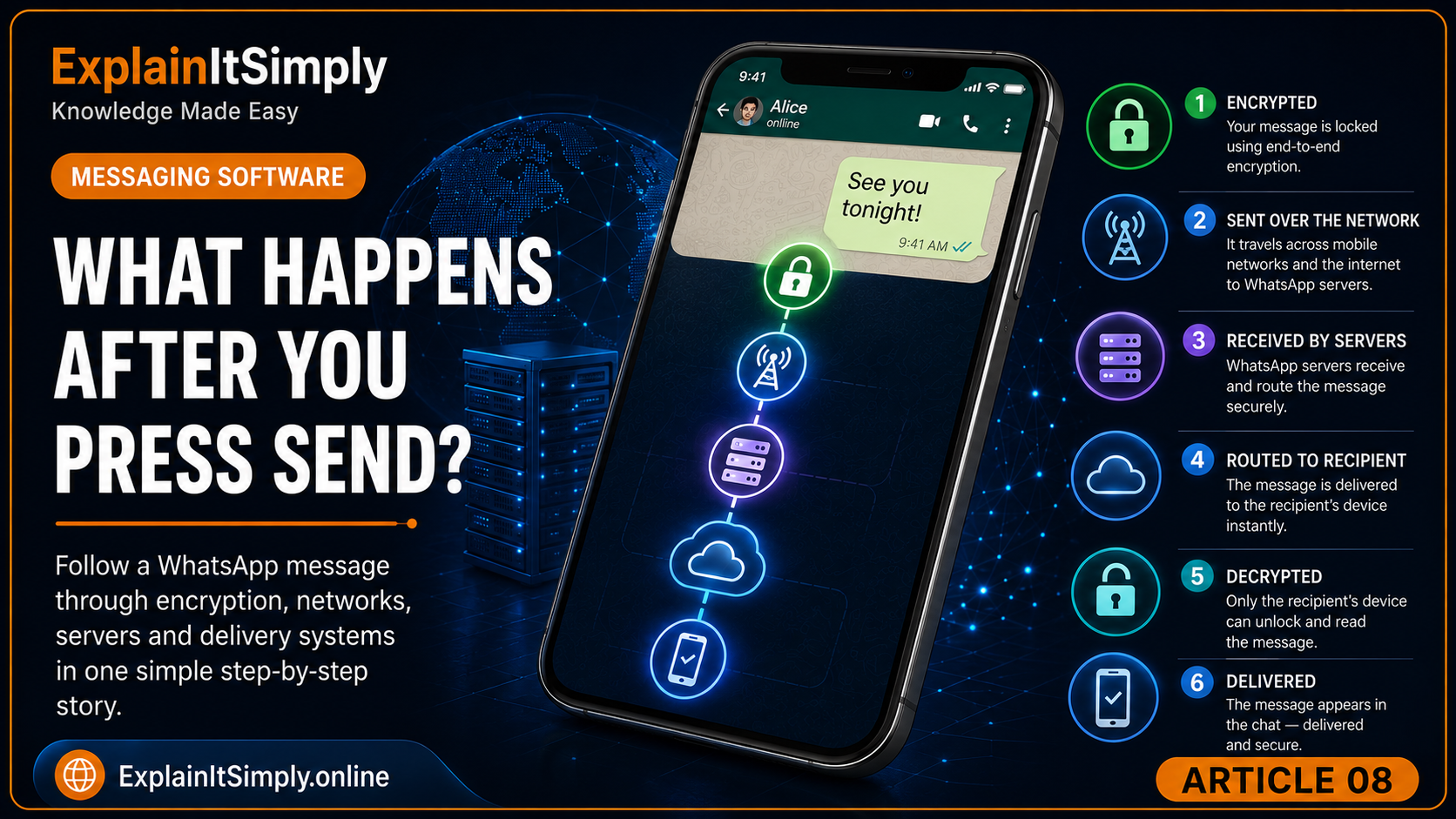
1The app prepares the message
The conversation, sender, time and message type are attached so the system knows exactly what it is handling.
2The message is protected
Encryption changes readable content into protected data before it leaves the sender's device.
3Your phone looks for a road
Wi-Fi or mobile data provides the first connection from your device into the wider internet.
4The service receives and routes it
Software identifies the destination account and decides which connected device or devices should receive the message.
5The recipient's device acknowledges delivery
When the destination device receives the message, that stage can be reported back to the sender.
6The conversation is updated
Your screen changes from a waiting symbol to delivery indicators so you can see where the message is in its journey.
Those mysterious ticksThe symbols are a tiny delivery report
People often describe the ticks as if they mean only “working” or “not working.” They actually represent different stages.
The message left your phoneThe service has accepted responsibility for trying to deliver it.
The destination device received itThe message reached at least one intended device.
The conversation was openedWhere read receipts are enabled, the app may report that the message was seen.
These statuses are produced by acknowledgements, small replies sent by systems and devices to confirm that a stage has been completed.
The message cannot be delivered to a phone that is not connected. Instead of forgetting it, the service keeps track of the pending delivery and tries again when the device reconnects.
This is why you can send a message at night and see it delivered only the next morning.
The hidden heroThe waiting line you never see
Consider a post office receiving thousands of parcels at once. It needs an organised waiting area so parcels are not dropped, repeated or sent to the wrong destination.
Messaging systems use the same basic idea. Work can be placed into controlled queues so the system knows what is still waiting, what is being processed and what must be tried again.
A queue is not exciting to look at, but it is one of the reasons a busy system can stay calm when millions of people are pressing Send.
Imagine if...Messages arrived in random order
“Yes” could arrive before the question. “I am outside” could arrive after you have already left. A joke's punchline could arrive before the setup.
Networks do not always move every piece of data at exactly the same speed. Software therefore needs identifiers, timing information and conversation rules to reconstruct a useful order.
A conversation feels natural only because software quietly manages the unnatural complexity underneath it.
What could go wrong?What if both people press Send at the same moment?
Two messages can enter the system almost together. Different devices may also have slightly different clocks. The software must still create a consistent conversation that makes sense when both screens update.
Now add group chats, several linked devices, edited messages, deleted messages, reactions and intermittent internet connections. The simple chat screen begins to look like a carefully coordinated shared record.
Behind the scenesHow can the message travel without being open for everyone to read?
End-to-end encryption is designed so the message is protected on the sender's device and intended to be readable only on the participating devices.
A simple comparison is a locked box. The transport system can carry the box and read the address, but the valuable content remains locked for the intended recipient.
No comparison is perfect, but it helps separate two jobs: routing the message and understanding its private content.
The bigger pictureNow imagine millions of these journeys happening together
One message is easy to picture. A global messaging service must deal with enormous numbers of conversations, media files, calls, group updates and delivery acknowledgements.
Traffic is spread across many machines. Copies of important data may be kept in more than one place. Monitoring systems watch for slowdowns. Engineers prepare for failures because a single machine cannot be allowed to become the entire service.
From a software developerThe real challenge is not sending one message
The real challenge is sending everyone's messages correctly, privately and quickly, even when devices disconnect and parts of the system fail.
A feature is only truly finished when the unusual situations have also been considered.
The human storyReliable messaging is really about trust
People use messages for ordinary jokes, family updates, school notices, work instructions, payments and emergencies.
When someone presses Send, they expect the right person to receive the right content once, not someone else, not ten times and not three days later without warning.
The hidden software matters because the conversation matters.
Next time you...Press Send
Watch the status change. You are seeing a tiny summary of a much larger journey through devices, networks, security and delivery software.
Over coffeeAsk someone this question
“Where do you think a message waits when the other person's phone is offline?”
The answer opens a surprisingly large conversation about how modern communication works.
🤔 The Next Time...
The next time you press Send
Your message will appear to leave instantly, but its real journey has only just begun.How many phones, networks, security checks, queues and servers worked together before the other person saw it?