RM
Ronnie Mbuqe
Author · ExplainItSimply
2 August 2026
24 minute read
English
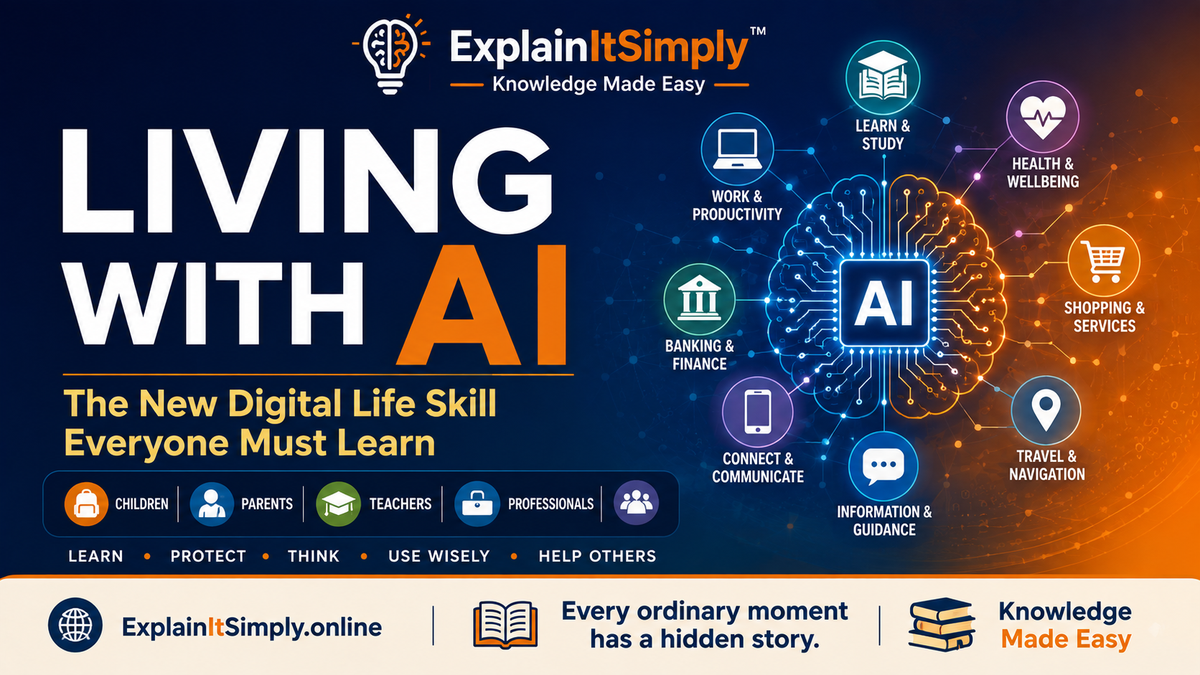 The question of our generation
Everyone is learning how to live with artificial intelligence for the first time
Children, parents, teachers, professionals and older adults are all using AI, but very few of us were taught how to question it, protect our information or know when a real person must take over.
A change touching every age
We are the first generation learning to live with AI together
Every generation has had to learn how to live with a powerful new technology.
Families learned how to use electricity safely. Drivers learned the rules of the road. Workers learned computers. Entire communities learned how to search, shop, communicate and protect themselves on the internet.
Artificial intelligence is the next major change, but this time children, parents, teachers, professionals and older people are meeting it at almost the same moment.
A learner may use AI to understand homework. A teacher may use it to prepare a lesson. A parent may ask it for advice. An employee may use it to draft an email. A business owner may ask it to analyse information. An older person may ask it about medication, banking or a suspicious message.
The important shift
The question is no longer only “Should we use AI?”
AI is already part of many phones, applications, workplaces, schools and services. The more useful question is: How do we use it wisely without surrendering our privacy, judgement or responsibility?
One evening · five people · five AI conversations
AI may already be speaking to everyone in the home
A child asks a chatbot to explain fractions. A teenager asks it to help write an assignment. A parent asks for advice about a difficult conversation. Another adult uploads a work document for a summary. A grandparent asks whether a message from the bank is genuine.
The same tool can be helpful in every situation, but the risk is not the same. A simple explanation of fractions is different from medical guidance, confidential work information, emotional advice or a decision involving money.
The life skill is not merely knowing how to ask AI a question. It is knowing what should not be shared, what must be checked, when the answer may be unsafe and when another human being is needed.
More than a computer skill
Why living with AI is becoming a digital life skill
Knowing how to operate a phone is a technical skill. Knowing whether a message is a scam, whether an answer is trustworthy and whether personal information should be shared requires judgement.
AI literacy means understanding what AI can do, where it can fail and how it may use information. But we need something more than literacy. We need digital wisdom.
Digital wisdom
Knowing how to use technology is a skill. Knowing when to trust it, when to question it, when to involve another person and when to put it down, that is wisdom.
Digital wisdom does not require everyone to become a programmer. It requires ordinary habits: pause before sharing, verify important information, protect private data, understand that confident language is not proof, and remain responsible for the final decision.
A powerful opportunity
AI can genuinely help people learn, create and participate
This article is not an argument against AI. Used carefully, AI can become one of the most useful tools available to ordinary people.
📚
Learning
It can explain a difficult idea in simpler words, provide examples, create practice questions and help a learner approach a topic from another direction.
🌍
Language and access
It can translate, summarise, read text aloud and help people communicate across language or accessibility barriers.
💡
Creativity
It can help someone brainstorm, plan, compare ideas or move past the fear of an empty page.
⚙
Work
It can assist with drafts, repetitive tasks, research preparation and organising information, while a person remains responsible for accuracy and quality.
♿
Independence
AI-supported tools can help people with disabilities access information, communicate and complete tasks more independently.
🔎
Curiosity
It can make it easier to ask follow-up questions without embarrassment and explore topics at an individual pace.
The opportunity is enormous. But a useful tool becomes safer when the person using it understands its limits.
💡 Did you know?
AI can sound confident without knowing that it is wrong
Generative AI produces likely language from patterns. A smooth, detailed answer can still contain invented facts, missing context, outdated information or an unsafe recommendation. Confidence in the wording is not evidence that the answer is true.
The first safety lesson
AI is not a search result, a teacher, a doctor or a trusted adult
AI may play parts of these roles in a conversation. It can explain, suggest, compare and respond. That does not mean it carries the qualifications, lived understanding, duty of care or responsibility of a real professional or trusted person.
A chatbot may not know your full situation. It may misunderstand the question. It may not know that a child is frightened, that an older adult is being scammed or that a medical symptom requires urgent attention.
1
Low-risk question
“Explain photosynthesis in simple language.” AI can provide a starting point that the learner checks against school material.
2
Important factual question
“What does this law mean?” The answer should be checked using an official source or qualified professional.
3
Health or safety question
“Should I stop taking this medication?” AI must not replace a doctor, pharmacist or emergency service.
4
Emotional crisis
“I feel unsafe and do not know what to do.” A trusted adult, qualified counsellor or appropriate emergency support must become involved.
The risk adults cannot ignore
Child + smartphone + AI + personal data + little adult supervision
Each part of this combination can be useful. Together, without guidance, they can create a serious risk.
A smartphone is not only a screen. It may contain a camera, microphone, location history, contacts, photographs, messages and access to applications. AI can make the conversation feel immediate, private and personal. A child may therefore share more than they would share with an ordinary website.
Children need more than access to AI. They need adults who help them understand what it is, what it is not and what must never be shared.
Why children may trust it
A chatbot can feel patient, clever and always available
Children naturally learn through conversation. When a system answers immediately, remembers the topic and responds in a friendly tone, it can feel like a knowledgeable companion.
That feeling matters. A child may begin to believe that the system understands them like a person, keeps every secret safely or always knows what is best. The interface may feel human even though the response is generated by software.
A simple comparison
Would you allow an unknown person to question your child privately every day?
Most adults would want to know who the person is, what they are asking, why they need the information and what happens to the answers. We should bring the same awareness to AI applications and chatbots.
Guidance does not mean frightening children or banning every tool. It means teaching them that an AI conversation is not automatically private, that the system can be wrong and that some situations must always be brought to a trusted adult.
Private information can appear ordinary
What children may reveal without realising the risk
A child may not type a bank PIN or password, yet still reveal enough small details to create a picture of their life.
🏫
School details
School name, uniform, class, teacher, timetable, sports team or the route travelled each day.
📍
Location
Home area, live location, favourite places or where the family will be at a certain time.
📷
Images and voice
Selfies, bedrooms, family photographs, schoolwork, identity documents or voice recordings.
💬
Private feelings
Fears, loneliness, family conflict, bullying, relationships or moments when the child feels vulnerable.
👨👩👧
Family information
Parents' names, jobs, routines, travel plans, financial worries or details about siblings.
🔐
Security clues
Pet names, birthdays, favourite teams and other details that may appear in passwords or security questions.
A rule children can remember
If you would not put it on a public noticeboard at school, do not give it to an AI tool without checking with a trusted adult.
When words influence actions
What if a child follows unsafe, manipulative or simply wrong advice?
AI-generated advice can affect real behaviour. A child may follow incorrect health guidance, believe an invented fact, accept harmful relationship advice, attempt a dangerous challenge or keep a troubling conversation secret because the chatbot sounded reassuring.
The risk is not that every AI answer is harmful. The risk is that a child may not yet have the experience to recognise when an answer crosses a boundary.
Does the response ask for secrecy?
Does it request a photograph or personal detail?
Does it encourage danger, self-harm or harm to someone else?
Does it discuss sexual or age-inappropriate content?
Does it tell the child not to speak to an adult?
Does it create fear, pressure or urgency?
A child should be taught one clear response: stop the conversation and show a trusted adult. They should not fear punishment for asking for help.
Help without replacing learning
AI should support a child's thinking, not become the child's thinking
When AI completes the entire assignment, the learner may submit better-looking work while understanding less. The immediate result can hide a long-term loss: fewer chances to struggle, practise, make mistakes and develop independent thinking.
The purpose of education is not merely to produce an answer. It is to build the ability to reason, explain, question, create and continue learning.
✓
Helpful use
“Explain this paragraph in simpler words, then ask me questions to check whether I understand it.”
✓
Helpful use
“Show me another example, but do not solve my exact homework question.”
!
Risky use
“Write my complete assignment so that I can submit it as my own work.”
!
Risky use
Copying an answer without checking it, understanding it or following the school's rules.
🎓
Continue with education
AI Is Already Changing How We Learn
See how learners, teachers and families can use AI as a guide without replacing human learning.
→
Age does not guarantee digital wisdom
Adults and older people are also using AI in risky ways
Children may be more vulnerable, but adults are not automatically safe. Experience in life does not always translate into experience with AI.
🏥
Health decisions
Changing medication, delaying treatment or interpreting symptoms from one AI answer without consulting a qualified professional.
⚖
Legal decisions
Treating a general response as legal advice without checking the law, jurisdiction or a qualified adviser.
💳
Money and banking
Following investment claims, sharing account information or believing an AI-generated message, voice or video.
🏢
Work information
Pasting customer records, contracts, source code, passwords or confidential company documents into an unapproved tool.
📰
Misinformation
Forwarding a convincing answer, image or voice note without checking where it came from.
❤️
Personal advice
Allowing a chatbot to become the only source of emotional, relationship or parenting guidance.
The safety principle is the same at every age: use AI as an assistant, not as the final authority over important decisions.
Think before you type or upload
Your AI conversation may contain more personal data than you realise
Different services have different privacy policies, security controls and data-retention practices. Some may allow users to control whether conversations are stored or used to improve services; others may handle data differently.
The safe approach is simple: do not assume that an AI conversation is private merely because it feels like a one-to-one chat.
Information that should stay out of ordinary AI chats
- Passwords, PINs, one-time codes and security answers.
- Identity numbers, passport details and photographs of official documents.
- Bank-card details, account numbers and private financial records.
- Confidential work information, customer data and protected intellectual property.
- Private medical records or information that identifies another person.
- A child's full name, school, exact location, routine, photographs or private family information.
- Anything you do not have permission to share.
Before uploading a document or photograph, ask: Who owns this information? Who could be identified? Do I have permission? Is there a safer way to remove names and sensitive details first?
Seeing and hearing are no longer enough
AI can create convincing images, voices, messages and videos
For generations, people were told to believe their eyes and ears. AI-generated media makes that rule less reliable.
A voice note may sound like a family member. A photograph may show an event that never happened. A video may place words into a person's mouth. A message may imitate the tone of a bank, employer, teacher or government department.
Pause before acting
A familiar voice asks urgently for money
Do not rely only on the voice. End the call and contact the person using a number you already know. Ask a question only the real person should know. Urgency is often used to prevent careful checking.
AI awareness is therefore not only about using chatbots. It is also about recognising that the content arriving on our phones may have been generated or manipulated.
Guide, do not simply ban
What parents and teachers can do now
A complete ban may push AI use out of sight. Unlimited access may leave children without protection. A better path is guided use, clear boundaries and regular conversation.
1
Explore together
Ask the child to show how the tool works. Try a homework explanation together and discuss what was useful or questionable.
2
Create family and classroom rules
Agree on suitable tools, age limits, what information may never be shared and when an adult must be involved.
3
Teach verification
Compare important answers with a textbook, teacher, official website or another reliable source.
4
Protect human learning
Require learners to explain the answer in their own words, show their process and identify what came from AI.
5
Keep difficult conversations open
Children should know they can report a frightening, sexual, manipulative or confusing AI response without being blamed.
The missing layer
Artificial intelligence is changing faster than society is learning how to use it
The technology will continue to improve. New applications will appear. AI will become easier to access and harder to notice because it will be built into ordinary services.
Our protection cannot depend only on recognising one application or one logo. It must come from habits that remain useful when the technology changes.
Digital wisdom is the habit of remaining human inside the decision: questioning, checking, protecting, caring and accepting responsibility.
The ExplainItSimply AI safety checklist, for every age
- Protect personal information. Do not share passwords, PINs, identity documents, banking details, precise location or confidential records.
- Assume important answers need checking. Use official sources and qualified people for health, legal, financial, safety and educational decisions.
- Keep a human in the loop. Children need trusted adults; adults need professionals and responsible colleagues when the stakes are high.
- Ask where the information came from. A detailed answer without a reliable source may still be wrong.
- Watch for pressure and secrecy. Stop when a system or person asks for secrets, images, money or urgent action.
- Use AI to support thinking. Ask for explanations, examples and feedback, not only finished answers.
- Respect other people's information. Do not upload private content without permission.
- Check the tool's settings and age requirements. Privacy and safety options differ between services.
- Take breaks. AI should not replace sleep, play, exercise, relationships, teachers, parents or community.
- Remain responsible. AI may suggest; people still choose and live with the consequences.
A commitment worth sharing
The ExplainItSimply AI Pledge
I will use AI to learn, not to stop thinking.
I will protect my personal information and respect the information of others.
I will verify important answers.
I will remember that AI can make mistakes.
I will ask a trusted person for help when an answer affects health, safety, money, law or emotional well-being.
I will use AI to help people, not to deceive, embarrass or harm them.
I will keep learning, because understanding AI is becoming one of the most important life skills of our generation.
Responsible guidance
Where the safety principles in this article come from
The practical advice in this article is consistent with guidance from organisations working on children's rights, education, consumer protection and digital well-being.
- UNICEF: Guidance on AI and Children: including safety, privacy, fairness, transparency and children's well-being.
- UNESCO: Guidance for Generative AI in Education and Research: supporting human-centred and age-appropriate use.
- WHO: Online lives, offline consequences: on digital environments and young people's mental health and safety.
- FTC: Inquiry into AI chatbots acting as companions: including safety and data practices affecting children and teenagers.
This article provides general awareness, not medical, legal, financial or emergency advice.
Continue the journey
Understanding AI begins with ordinary moments
Living with AI begins with one decision
Our grandparents learned to live with electricity. Our parents learned computers. We learned the internet. Our children will grow up with artificial intelligence.
The greatest advantage will not belong to the people who simply use AI the most. It will belong to the people who understand it, question it, protect themselves and continue thinking for themselves.
The next time you ask AI a question, ask yourself one more: Am I still doing the thinking?
🤔 The Next Time...
The next time AI gives you an impressive answer
Pause before you copy, share or act.What should I protect, what should I verify, and which human being should remain part of this decision?