RM
Ronnie Mbuqe
Author · ExplainItSimply
October 2026
13 minute read
English
The Moon you aim at is already on its way somewhere else
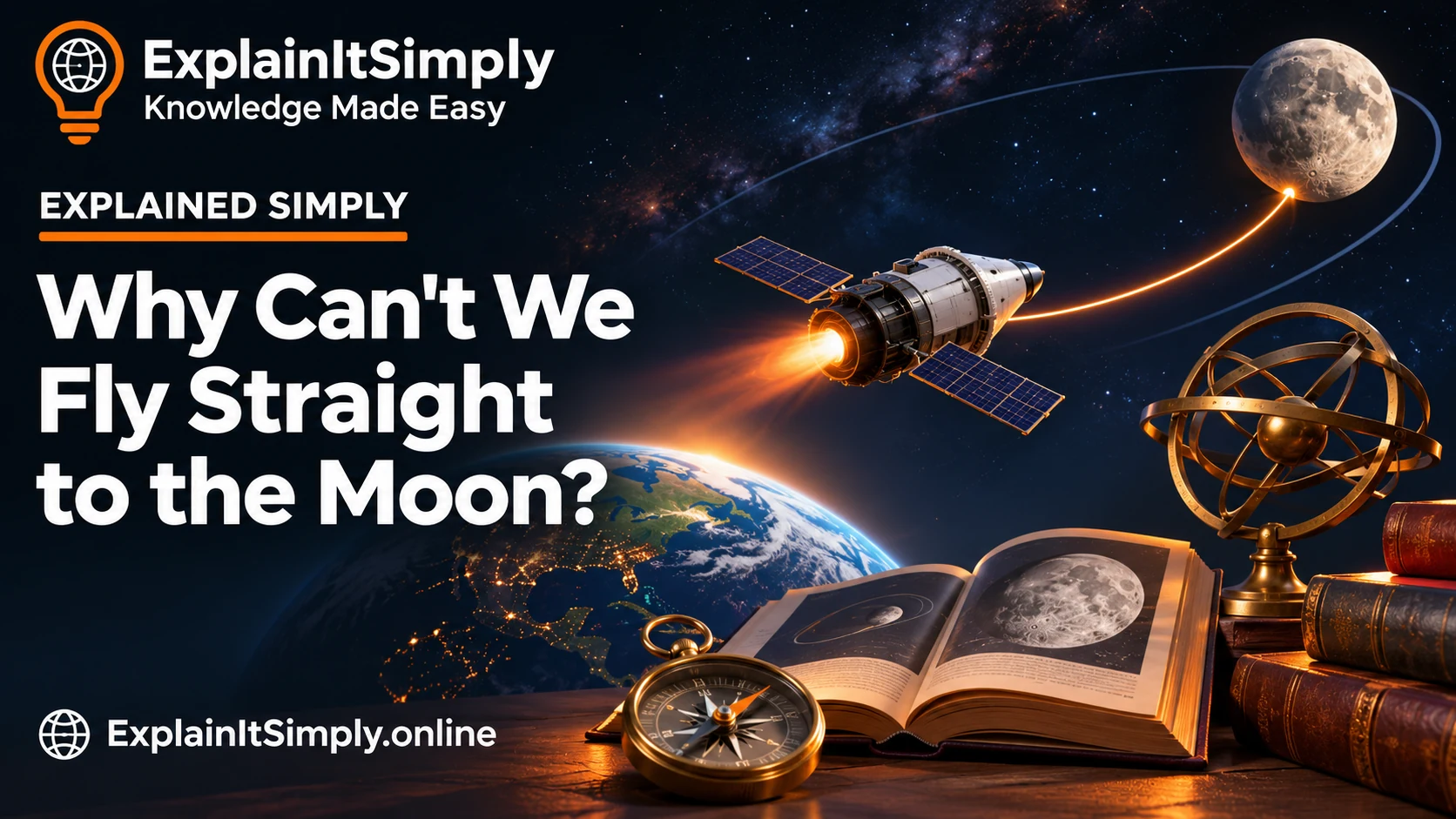
Imagine passing a ball to someone running across a field. Throw at the place they occupied when you started and the ball can arrive perfectly at an empty patch of grass. A Moon mission has the same interception problem, with gravity and far greater distances added.
The Moon's average distance from Earth is about 384,400 kilometres, and it completes an orbit against the stars in roughly 27.3 days. It therefore changes position appreciably during a journey lasting several days. Mission planning needs a future meeting point, not simply the direction of the Moon at launch.
“Why not fly straight there?” is a useful starting question, but a spacecraft is not drawing a line on a stationary map. It moves through gravitational fields while Earth and the Moon keep moving. A path that looks curved in one reference frame can look different in another.
A delivery to a moving addressImagine giving a courier an address that travels while the parcel is in transit
A normal delivery address is effectively fixed for the journey. The Moon is not. A spacecraft launched towards today's lunar position would need its path planned around where the Moon and spacecraft will both be at arrival. The mission is a timed meeting, not a distance-only race.
In our circular teaching model, the Moon moves roughly 13 degrees around Earth each day. Over three days, that is about 40 degrees. This does not tell us exactly where to point a rocket: a rocket also starts on a rotating Earth, and the spacecraft follows a path determined by its initial motion and changing gravity.
A mission reference trajectory describes the intended path and timing. Navigation estimates the actual state of the spacecraft and compares it with that plan. Small corrections can then address differences before they become an unacceptable miss.
The useful everyday comparison is steering towards a future meeting with a moving person. The limitation is that a spacecraft is not free to turn like a car at every corner. Changing velocity consumes resources, and the consequences of a burn unfold over the rest of the trajectory.
The rocket first has to change motion, not just gain height
Going upward clears the surface, but height alone does not provide the motion needed for an orbit or lunar transfer. Many missions first establish an Earth parking orbit, then make a burn that changes the spacecraft's trajectory toward the Moon. Other mission designs use different sequences.
An engine produces thrust by expelling propellant. It can change the spacecraft's velocity: both speed and direction matter. After a burn, the craft can coast while gravity continues to change its motion; an engine does not have to push continuously just to keep it moving.
That is why dividing distance by a rocket's headline top speed does not give a useful mission duration. The speed varies along the trajectory, and the goal includes arriving with an appropriate position and velocity. A fast flyby and a controlled lunar arrival solve different problems.
Why does the average distance not give one universal travel time?
Distance divided by speed gives time only when the distance and speed assumptions describe the same journey. A lunar spacecraft does not necessarily travel at a constant speed along a straight line equal to the Moon's average distance. Different missions choose different paths and arrival requirements.
Questions a real trajectory must answer| Quantity | What changes the answer? |
|---|
| Distance travelled | The chosen path, not just centre-to-centre separation |
| Speed along the path | Engine burns and gravitational acceleration |
| Destination position | The Moon's motion during the flight |
| Arrival conditions | Flyby, orbit or landing requires different relative motion |
For a deliberately artificial arithmetic example, 384,400 kilometres at an unchanging 1,000 kilometres per hour would take 384.4 hours, or about sixteen days. That result is correct for the stated calculation and unsuitable as a lunar mission plan. The assumed speed, straight path and fixed distance were never established for a real spacecraft.
This is an important general lesson about calculators: correct arithmetic does not validate the model supplied to it. Before trusting a travel-time result, ask what motion and route it actually represents.
How far does the target move while you travel?
Use a deliberately simple classroom model: a circular lunar orbit taking 27.3 days, with constant angular motion. Divide 360 degrees by the period, then multiply by a chosen journey time. Three days gives about 40 degrees of orbital movement.
This does not calculate a launch direction or a safe spacecraft trajectory. It ignores the detailed gravity, geometry and starting conditions. It isolates one idea: the destination cannot be treated as a fixed dot during the trip.
Increasing journey time moves the target farther in this model. A real flight planner simultaneously chooses a feasible transfer, checks arrival conditions and accounts for uncertainties. The circular demonstration is a question-generating tool, rather than a navigation system.
If the engine is off, why does the spacecraft keep moving?
A car on a road needs ongoing power partly because air resistance and contact forces remove energy from its motion. In space, a coasting spacecraft does not encounter the same road and atmosphere. It continues moving while gravity and other relevant forces affect its path.
“No thrust” is not “no forces”. Near Earth and the Moon, their gravitational attraction remains essential to the trajectory. An engine-off segment can therefore curve and change speed without violating the idea that motion does not require a constant forward push.
A burn can increase speed, reduce it or change direction depending on where and how the thrust is applied. To slow relative to a destination, the spacecraft must arrange the required change in velocity. Simply switching the engine off is not equivalent to applying brakes on a road.
That distinction explains why a probe can coast for a long period but still need a critical burn at arrival. The vehicle is conserving a resource during one part of the trip, not escaping the need to control its final state.
Reaching the Moon's neighbourhood does not mean you will stay there
A spacecraft can pass the Moon and continue onward. To enter a desired lunar orbit, it must have suitable motion relative to the Moon. Depending on the trajectory, a carefully planned engine burn or another transfer design changes that relative motion.
Landing adds another requirement: reduce the velocity enough to meet the surface safely. The Moon has no substantial atmosphere for an ordinary parachute landing. A powered lander must manage its descent, fuel, terrain and navigation.
Think of arriving at a station aboard a moving train. Being beside the platform is not enough if you are still moving too quickly to step off. The analogy is limited, but it makes the missing ingredient visible: matching position is not the same as controlling velocity.
How do engineers know where a distant spacecraft actually is?
Ground-based navigation uses observations such as radio tracking to estimate the spacecraft's position and motion. Different measurements constrain different parts of its state. The estimate contains uncertainty; it is not a perfect dot supplied by a cosmic address system.
Compare an intended route with an actual journey on Earth. Knowing where you were an hour ago is not enough unless you also know how you moved afterwards. Spaceflight extends that problem into three dimensions and requires accurate timing, observations and physical models.
Navigation teams combine observations with a trajectory model, update the estimate and decide whether a correction is needed. Instruments and methods differ by mission, and spacecraft can also use onboard sensing. No single device magically removes all uncertainty.
Communication time is another reason to plan carefully. A radio signal travels at light speed, not instantaneously. A command-response exchange and the processing around it take time, so a mission cannot be treated as an ordinary remote-control toy with perfect live feedback.
Why not carry enough fuel to correct every mistake?
Extra propellant adds mass, which itself must be accelerated. Extra tanks and hardware add more mass. Spacecraft design is therefore a set of linked budgets rather than a shopping list of unlimited backup equipment.
A mission's velocity-change budget helps organise the burns it needs and the margin available for corrections. The technical term is delta-v. It measures change in velocity, not the number of kilometres on a route.
Some trajectories trade longer travel time for different energy demands; others favour shorter journeys or particular arrival conditions. “Fastest” is not automatically “best” when instruments, crew needs, fuel and mission objectives must all fit together.
What changes if the mission must land and bring someone back?
A flyby can collect information while continuing past the destination. An orbiter must achieve a suitable bound path. A lander must manage descent and reach a safe surface location with acceptable motion. These are progressively different mission objectives, not merely different labels for arriving near the Moon.
A return mission adds ascent, rendezvous where required, departure and Earth arrival. Each stage depends on earlier decisions about mass, propellant, power and hardware. Landing a component that is not needed on the surface can impose a cost on both descent and ascent.
The design question is therefore “What must each part do, and where must it go afterwards?” Apollo's separate lunar module is one historical answer, not the only possible architecture. Understanding the jobs makes the hardware choices easier to assess.
Look at a launch photograph again and imagine the mission's later states. The most visually dramatic moment is only the start of a chain of planned changes in motion. Meeting the Moon safely depends on the whole chain.
The return trip starts in the plan before the first launch
A mission that intends to return must arrange departure from the Moon and arrival back near Earth with suitable conditions. A crewed mission must also support people throughout the journey. Food, power, temperature control and communication are part of the mission, not optional details around the rocket.
Apollo separated jobs between vehicles: the lunar module operated near the lunar surface while the command module supported the journey home. That architecture avoided landing and lifting the whole returning spacecraft. It required a carefully managed rendezvous.
The Moon is easy to point to and difficult to meet. The next time you see it, picture a moving destination, a planned velocity change and an arrival that must work in both space and time.
Sources and further reading
A closer lookAim for where the target will be
A spacecraft heads toward a destination that continues moving during the journey. Aiming at its starting position does not describe the full navigation problem.
Work through the distinction
Trajectory design accounts for motion, gravity, timing and corrections. A straight-line distance divided by one speed can illustrate a limit but cannot plan the mission.
Which position matters for rendezvous?
Choose an answer to see feedback. You can try again.
Show the answer and explanation
The target's position at arrival. Trajectory design accounts for motion, gravity, timing and corrections. A straight-line distance divided by one speed can illustrate a limit but cannot plan the mission.