RM
Ronnie Mbuqe
Author · ExplainItSimply
Published: 7 November 2026
7 minute read
English
If we were far away, could we tell Earth was alive?
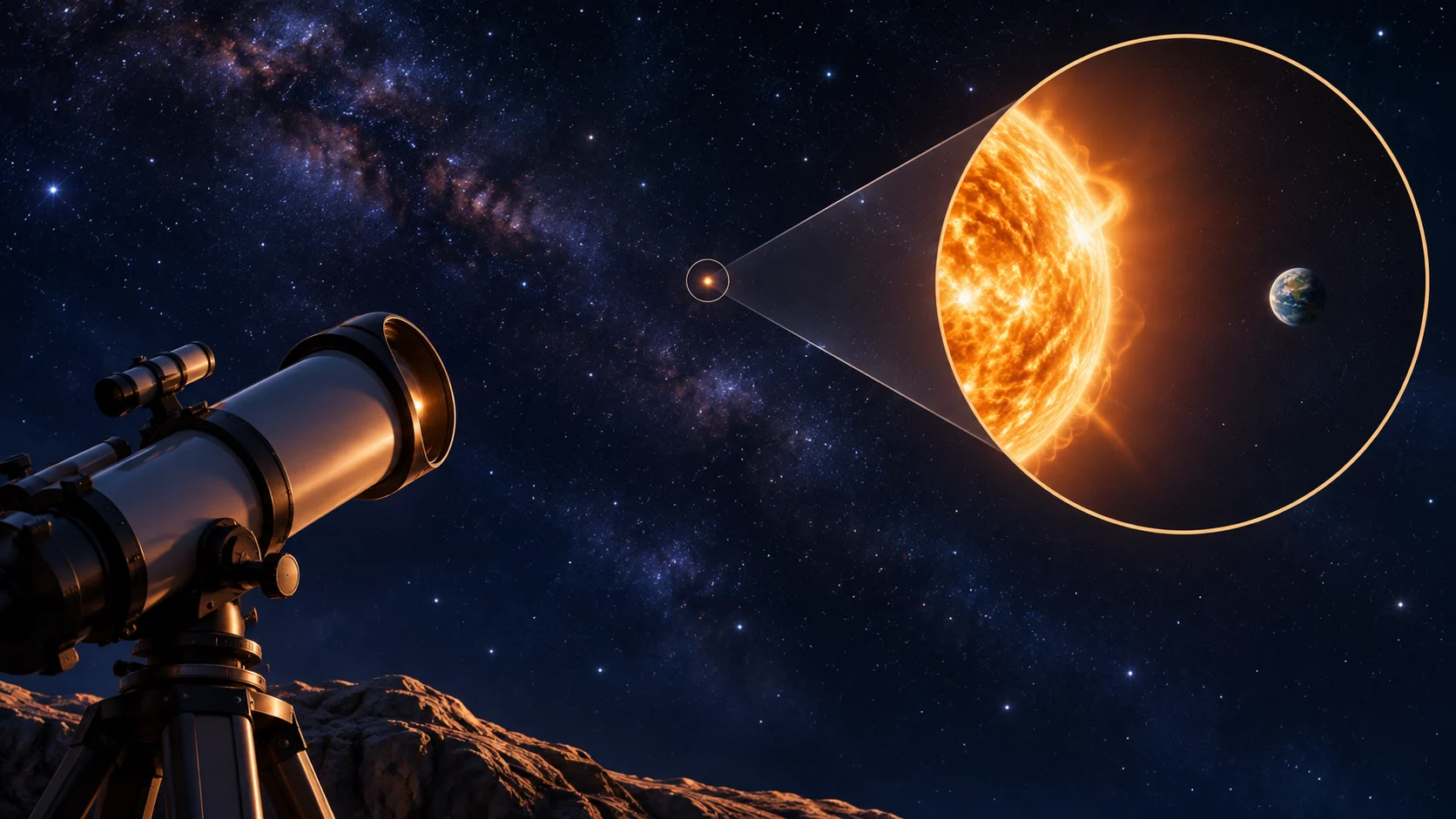
Imagine you grow up on a world orbiting a distant star. One night, you point a powerful telescope towards our Sun. You are hoping to see Earth. Even if your instruments can isolate its light, our world might look like a faint point. The oceans, trees, people and passing cars have all disappeared into that tiny signal. How would you decide whether anything lives there?
We face that problem in reverse. So far, Earth is the only world where life has been confirmed. There are good reasons to search elsewhere, and there are observations worth following up. An interesting world, a possible sign of life and a confirmed discovery each require a different level of evidence.
Would a second Earth be the first place to look?
A world does not need beaches, trees or even a familiar daytime sky to be worth investigating. On Earth, organisms survive in places that would be deeply uncomfortable for most of us. That gives scientists a reason to consider environments very different from where humans live.
Liquid water is a practical starting point because all known life uses it. Mars preserves evidence of ancient environments where water once flowed. Europa, a moon of Jupiter, is thought to have an ocean under its icy surface. These lead to different questions. On Mars, certain rocks may preserve chemical or physical traces of an ancient environment. At Europa, scientists can investigate whether conditions below the ice could support life.
Europa Clipper is designed to investigate Europa’s potential habitability. Habitability means that conditions could support some form of life. You still need to establish whether anything is actually there. Checking that a room has air, water and food would tell you a person could live there. To learn whether someone lives there now, you would look for a different set of clues.
How can a telescope read the air around a planet?
One common method begins when a planet passes in front of its star from our point of view. A small fraction of the starlight filters through the planet’s atmosphere before reaching the telescope. Molecules absorb some wavelengths more than others. The pattern of which wavelengths are missing or weakened helps researchers infer what gases could be present.
Think of listening to a song through a wall. Some parts come through more easily than others. The version you receive carries clues about what the sound passed through. In astronomy, those clues are measured by instruments and compared against models. The analogy is the change in a signal passing through something. The telescope is measuring light, and the details depend on how molecules interact with it.
The task is hard because the signal is small. The star itself can vary. The instrument has limits. Clouds and haze in the planet’s atmosphere can obscure features. More than one combination of gases and atmospheric conditions can sometimes fit the available data. Repeated observations and independent analyses help narrow the possibilities.
Could a gas fool us into thinking a planet is alive?
Imagine a fictional planet on which researchers think they have detected oxygen. On Earth, living organisms helped build up the atmosphere’s oxygen over time. That makes oxygen interesting. Other processes can also produce it. Under some conditions, starlight can break apart water molecules, allowing lighter hydrogen to escape and leaving oxygen behind.
The next step is to ask what else we know. How active is the star? Are there signs of water or evidence of substantial water loss? Do another instrument and another analysis see the same features? Can a model of the planet’s chemistry produce the observed mix without biology?
Would you announce a discovery?
You are reviewing three fictional findings. Decide how far each lets you go, then open it to compare your reasoning.
A single telescope finds a weak feature that could be oxygen
Start by repeating the measurement. The feature could come from another molecule, a variable star or instrument noise.
Two teams confirm oxygen around a planet that appears to be losing water
The gas is more credible. Water loss gives you a non-biological explanation to test before making a claim about life.
Several gases are confirmed and the chemistry models disagree about their origin
There is a promising target for follow-up. Look for measurements that distinguish the competing explanations and make the uncertainty clear.
A second interesting gas might strengthen the case if the two gases should react away and something appears to keep replenishing them. The surrounding environment still matters. A serious claim explains why biological and non-biological possibilities fit the full collection of observations differently. It also has to survive attempts by other teams to find measurement problems or explanations the first team missed.
What would a convincing discovery look like?
The strongest evidence depends on what scientists can reach. A distant planet might be studied through repeated spectra and other measurements of its environment. A sample from a nearby world, if available, could be examined for chemical patterns, structures and their geological surroundings. In either case, independent teams would want to see whether several lines of evidence agree.
Context matters even for an apparently striking result. Tiny shapes in a rock can resemble cells while forming through non-living chemistry. A useful analysis asks how the rock formed, whether the shapes are linked to distinctive chemistry, and whether the result can be reproduced. A sample handled on Earth would also require careful checks for contamination. A researcher making a sound claim must show where the evidence came from and why it belongs to the sample.
If someone is out there, why haven't they called?
Searching for life and searching for technology are different investigations. A world with microbes could remain alive for a very long time without broadcasting a message. A technological society might send signals in directions we are not watching, at frequencies we have not checked or during an era that does not overlap with ours.
Consider a world 100 light-years away. If someone there transmits a signal today, we could receive it 100 years later. If we immediately answer, our reply takes another 100 years to reach them. Even a successful first contact by radio could unfold over generations. At the same distance, a telescope on that world would receive Earth light that left a century ago.
The Fermi paradox is the tension between how plausible it can feel that technological life exists elsewhere and how little confirmed evidence we have found. Distance, timing and the way we search are possible pieces of that puzzle. We also have a very small sample of known life-bearing planets: one. That makes it difficult to tell which parts of Earth’s story are common and which might be rare.
Look up at a star tonight and imagine somebody far away working with the light from ours. What one measurement would you want them to make? What natural explanation could fool them? Once you start asking both questions, you are thinking like someone trying to find life in the universe.
Could we miss life even while looking in the right place?
Imagine a living world with most of its biology beneath an ice shell. From far away, you might see the ice and learn very little about what happens under it. Even on a rocky planet with an atmosphere, life might produce too little of a particular gas for our instruments to detect. A quiet reading can reflect the limitations of our equipment or the particular signal we chose to look for.
This makes the search a two-sided problem. Scientists try to avoid sounding an alarm when ordinary chemistry explains the data. They also ask whether their methods could overlook a living planet. Every observation is tied to a particular instrument, target and question. A result such as “we did not detect this gas” tells us something narrower and more useful than a sweeping claim about everything that might live there.
Sources and further reading
Explore the other questions in this series