RM
Ronnie Mbuqe
Author · ExplainItSimply
Published: 12 November 2026
6 minute read
English
If the Moon spins, why does it always show us the same face?
Look at a full Moon from South Africa and notice the large dark patches that give its face its familiar pattern. Come back on another clear night and the bright portion may look quite different, but the features still belong to the same broad half of the Moon. That seems odd. If the Moon rotates, surely the back should eventually come into view?
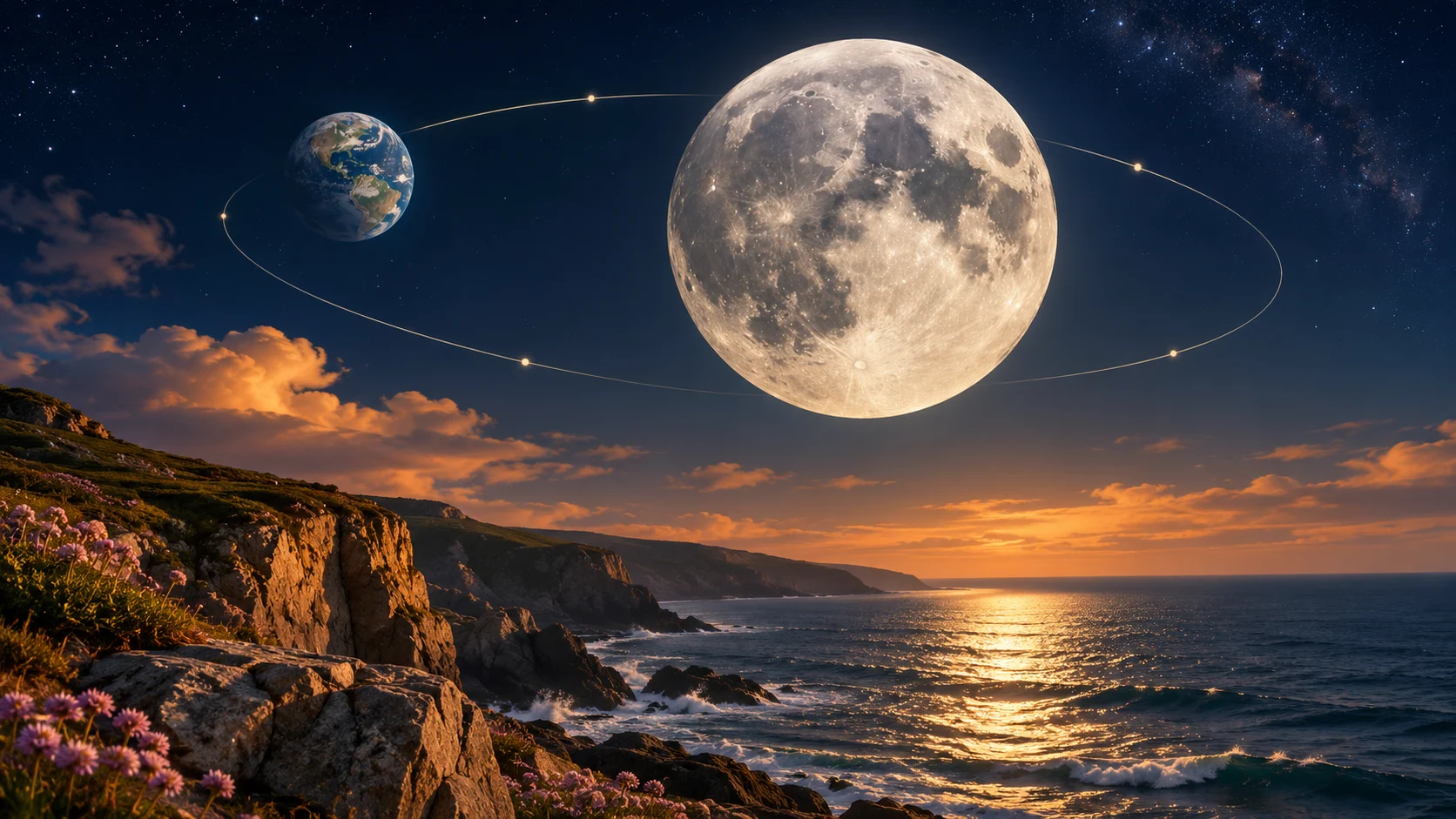
The Moon makes one spin in about the same time it takes to travel once around Earth, approximately 27.3 days relative to distant stars. These movements go in the same direction. As the Moon moves around Earth, it turns by the right amount to keep nearly the same hemisphere facing us. Astronomers call this synchronous rotation, a common result of tidal locking.
Can you prove it with a chair?
Put a chair in the middle of a room. Stand a step or two away and face it. Walk a full circle around the chair while keeping your chest pointed at it. On the far side, you will be looking back towards the wall that was originally behind you. By the time you return to where you started, you have turned through a full circle relative to the room.
Now do the walk again while keeping your chest pointed towards the same wall throughout. You may need to step sideways and backwards. The chair now sees your front, one side, your back and your other side as you go around. Your orientation relative to the room stayed fixed. Your orientation relative to the chair changed with your position.
This gives us a way to settle the puzzle. Ask what the Moon is turning relative to. Relative to distant stars, it turns once per orbit. Relative to the line towards Earth, it keeps almost the same face. The reference you choose changes the description, while the motion stays the same.
Why would gravity make the spin match the orbit?
Earth pulls on the whole Moon, but its pull is slightly stronger on the nearby side than on the far side. That difference produces a tidal deformation. The Moon is mostly solid rock, but solid rock can deform slightly on the scale of a whole world.
Imagine the ancient Moon spinning at a different rate from its orbit. Earth’s gravity would continually pull on the slightly stretched Moon. The deformation and the direction towards Earth would not stay perfectly aligned as the Moon turned. Earth’s pull on that misaligned shape would twist the Moon, and repeated flexing dissipated energy as heat.
Over a long time that process brought the Moon’s spin into step with its orbit. Picture a door settling into a position in which the force on it produces much less turning. The details of the early Moon involved many changes, but the simple lesson is that a difference in gravitational pull can affect how a world turns, as well as the path it follows.
Is the far side always dark?
Stand next to a lamp and hold up a ball. One half of the ball is lit. If a friend walks around it, the part of the lit half they can see depends on where they stand. The lamp is the Sun. Your friend’s view is what we get from Earth. The part of the Moon turned towards Earth and the part turned towards the Sun follow different rules.
At full Moon, most of the face towards Earth is sunlit. Around new Moon, most of that same face is dark to us and the far side has much more sunlight. The name “far side” describes the view from Earth. It has its own day and night.
During a crescent Moon you can sometimes see a faint outline of the rest of the near side. Sunlight reflected from Earth illuminates that surface weakly. The bright crescent is lit directly by the Sun and the dim outline is largely lit by Earth. It is a nice chance to see one world provide light to another.
Why are the phases about 29.5 days apart?
The orbital period of about 27.3 days is measured against distant stars. During those weeks Earth and the Moon also travel around the Sun. By the time the Moon is back in the same direction relative to the stars, the direction towards the Sun has shifted. The Moon travels a little farther to get back to the same Sun–Earth–Moon arrangement.
That is why the time between new moons averages about 29.5 days. The two numbers answer different questions. One measures a trip around Earth against a background of stars. The other measures how long it takes until the familiar pattern of illumination repeats.
Can we ever see around the edge?
There is a wrinkle in the phrase “the same side”. The Moon’s orbit is slightly elliptical. Its orbital speed varies while its average spin rate stays almost steady. This lets us see a little farther around opposite sides at different times. The way the Moon is tilted relative to its orbit also lets us peek slightly over and under its usual view.
Those apparent nods and shakes are called libration. Over time they let observers on Earth see about 59 percent of the lunar surface in total. At any one time the view is still close to half. If you compare photographs taken on different dates, find a crater close to the edge and see how its apparent distance from that edge changes.
Camera orientation can add another change. People in different hemispheres view the Moon with different local senses of “up”, and its orientation against the horizon can change as it crosses the sky. A lunar photograph may be rotated compared with the Moon you remember. The familiar craters are still there. Match the features before deciding you are looking at a different face.
How do we know what the far side looks like?
Spacecraft can fly beyond the range of what we see from the ground and photograph the far side directly. The Soviet Luna 3 spacecraft returned the first photographs of it in 1959. The unfamiliar view has fewer of the broad dark plains that make the near side so recognisable. Later missions mapped the features in much more detail.
The key distinction is worth trying with the chair again. If you face the chair the whole time, a person watching from the room sees you turn. If you face the same wall the whole time, the chair would see every side of you. When you look at the Moon again, remember that keeping its face towards us takes a turn, all the way around.
You can repeat the comparison with two photographs of a full Moon taken months apart. Rotate the images until the biggest dark plains line up, then compare small craters near the edges. A change in the picture’s orientation is easy to undo. A change in which features sit near the rim tells you something about the angle from which you are looking. You have separated the camera’s viewpoint from the Moon’s motion using details you can see.
Sources and further reading
Explore the other questions in this series