By Ronnie Mbuqe
A mechanism connects an outcome to the steps and conditions producing it. Saying 'the app uses a database' does not explain how the correct record is selected.
Ask what enters the system, what changes and what determines the output. Then test the explanation by changing one input or condition.
RM
Ronnie Mbuqe
Author · ExplainItSimply
24 July 2026
20 minute read
English
Look closerLook beneath the connected systems around us
That is the pattern behind ExplainItSimply: we begin with the ordinary moment you can see, then follow the invisible steps until the result makes sense.
The story beginsOne normal day can contain six remarkable questions
You wake up and your phone recognises your face. A weather app checks distant servers and tells you whether to carry an umbrella. An aircraft crosses the sky while Earth rotates beneath it. A song stays in your mind, but an important fact disappears. Later, you check your balance and wonder how ordinary spending used so much money.
These moments belong to different subjects, but they share one important truth: the visible result is usually the final part of a longer story. ExplainItSimply opens that story, removes the intimidating language and connects the idea to something familiar.
?
The purpose of this blog
This is not a page of quick definitions. It is a front door for curious readers arriving from WhatsApp or social media, giving enough explanation to understand the big idea and clear paths into deeper guides.
Why does asking what happened between two steps produce a better explanation?
A result can hide several transformations.
Trace the explanation
Trace the input, the decision, the action and the evidence of completion. This approach turns a familiar outcome into a system you can investigate when it fails.
Source and further reading: MDN Web Docs
Simply explainedThe systems hiding inside ordinary life
A modern phone combines hardware, software, networks and AI. A website combines screens, APIs, servers and databases. Earth's daily sky comes from rotation and sunlight. An aircraft journey depends on physics, engines, pilots, software and air traffic control. Learning depends on attention, memory and practice. Money depends on flows, habits and choices.
Understanding becomes easier when we stop asking only, ‘What is it?' and begin asking, ‘What caused it? What happened next? Who or what controlled the process? Why was it designed that way?' Those questions turn facts into stories and stories are easier to remember.
AI
The phone that appears to know you
AI recognises patterns and predicts likely answers. It can perform impressive narrow tasks without having human understanding.
A closer lookTurn a surprise into a testable question
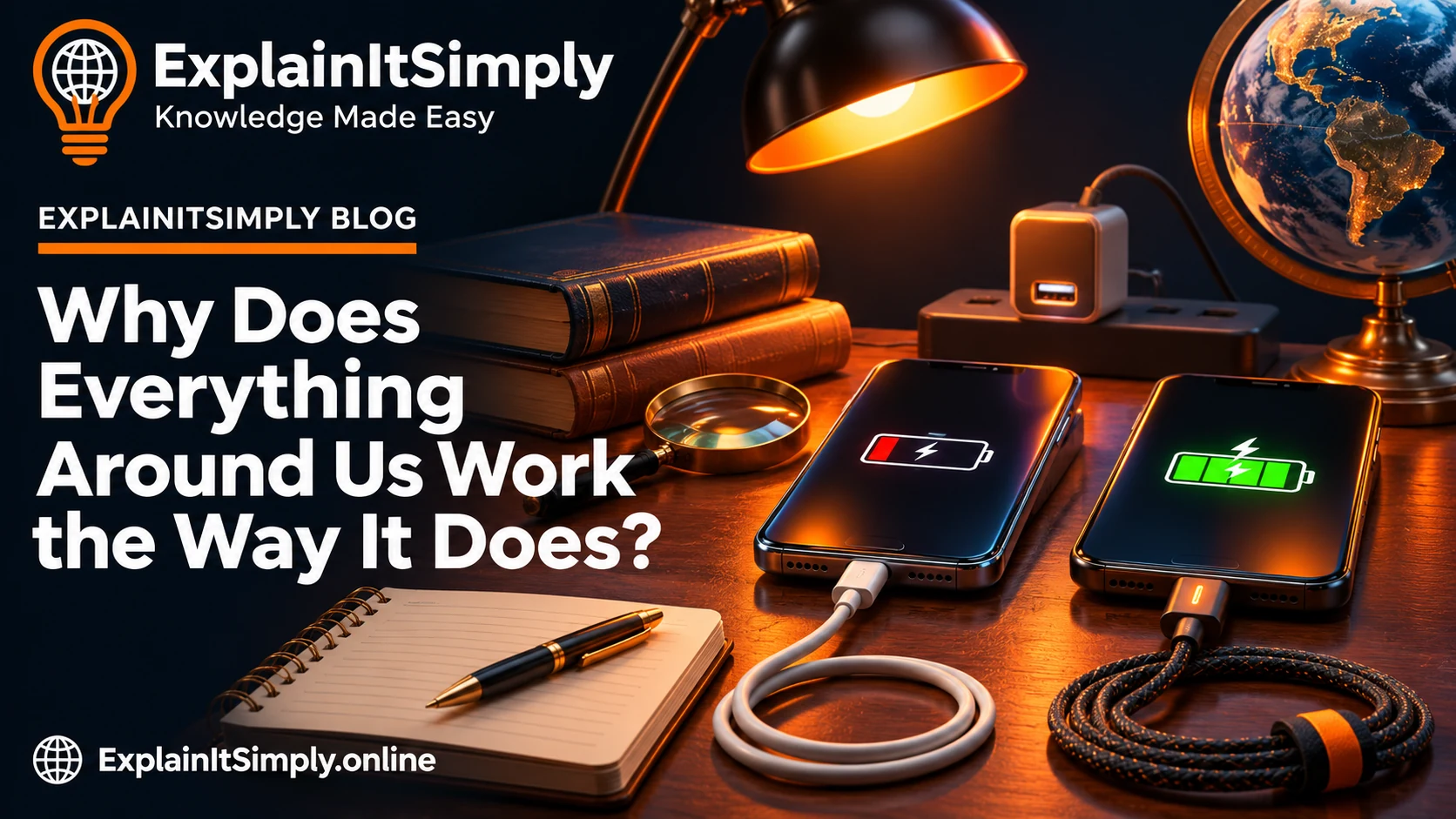
A phone charges slowly with one cable. Compare the same phone and charger using another suitable cable, while keeping other conditions as similar as practical.
Work through the distinction
Changing one factor at a time helps narrow explanations, though real systems can have interacting causes. Record what changed and what stayed the same. Avoid opening electrical equipment or trying unsafe experiments.
What makes the comparison useful?
Choose an answer to see feedback. You can try again.
Show the answer and explanation
Keeping other relevant conditions similar. Changing one factor at a time helps narrow explanations, though real systems can have interacting causes. Record what changed and what stayed the same. Avoid opening electrical equipment or trying unsafe experiments.
The hidden software journey
A button may contact many services before returning one simple message to the screen.
◉
The moving planet
Earth rotates and orbits while gravity keeps our everyday environment together.
✈
The controlled flight
An aircraft changes configuration and force balance from taxi through landing.
Follow a single day through the website's main subjects
This journey shows how the main sections connect instead of existing as isolated menus.
Morning: AI and the phone
Face unlock, suggested words and traffic predictions begin the day. Each feature uses data and patterns for a specialised task.
Online action: software responds
A booking or payment moves through the internet, server rules and databases before confirmation returns.
Look outside: Earth is moving
The Sun appears to cross the sky because your location is rotating with Earth.
Look up: an aircraft climbs
Engines, wings, pilots, computers and controllers cooperate to move a heavy machine safely into cruise.
Study time: memory chooses
Attention, repetition and recall determine whether information remains available later.
End of day: money tells a story
The balance reflects fixed costs and many small choices. A budget reveals the flow that memory may overlook.
What is the common cause behind all these different topics?
They are all systems. A system has parts, inputs, rules, actions and results. Once you identify those pieces, the mystery becomes manageable. The phone receives data. The aircraft receives control inputs and airflow. The budget receives income and spending decisions.
The funny part is that humans often trust a complicated system when it hides its complexity well, then become suspicious when someone explains it clearly. Simple English does not make the idea shallow. It makes the structure visible.
Why is 'what would happen if...' such a useful question?
A prediction forces an explanation to do work. If the mechanism is understood, changing a relevant condition should lead to a reasoned expectation.
For a simple price rule, change the quantity while keeping the rate fixed. Then ask whether the real system also includes discounts or limits before transferring the prediction.
A familiar result can hide several mechanisms working together
An online booking combines human choices, software rules, data records and payment processes. Explaining only the visible button misses why a request can fail after the screen seems ready. A useful explanation names the boundary where one part hands work to another.
Try the same habit with a different subject. A tide needs gravity differences and a local ocean response; a study result needs practice and feedback. Asking 'what causes the next step?' builds an explanation rather than a list of interesting nouns.
Observe a familiar result to Test the explanation on a new case
Is an analogy a substitute for explaining where the comparison stops working?
No. An analogy highlights a useful relationship and also has limits. State the mechanism in the real topic and identify what the analogy leaves out.
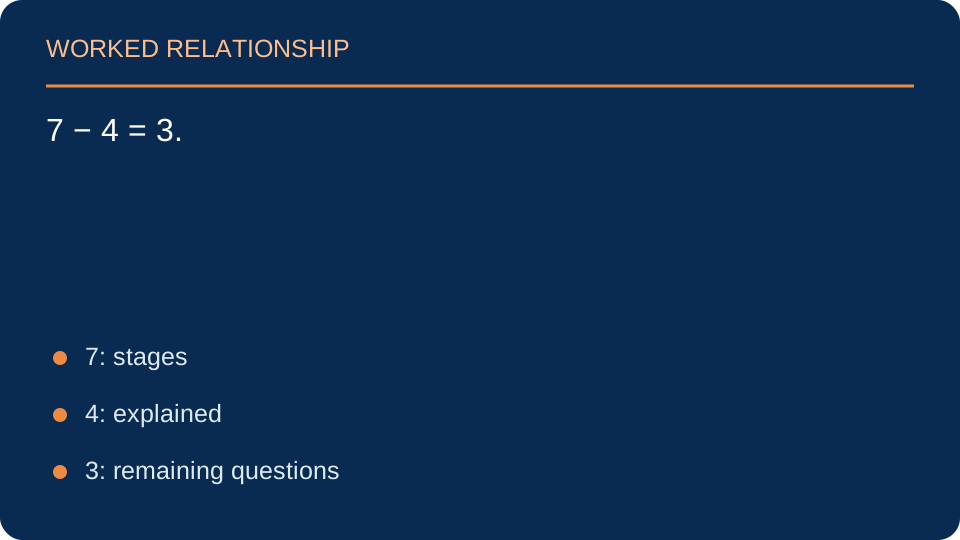
A fictional process has 7 stages and you have explained 4. How many stages remain unexplained?
Trace the explanation
7 − 4 = 3. A missing stage is a question to investigate, not an invitation to fill the gap with a confident guess.
Source and further reading: MDN Web Docs
Where this appears in real lifeWhy these explanations matter in daily life
Understanding does not need to turn everyone into an engineer, pilot or accountant. It gives people confidence, better questions and safer choices.
✓
Better technology choices
Knowing what AI and software can and cannot do helps you use tools without treating them as magic.
✓
Less fear of science
Space and aviation become understandable when motion, forces and systems are explained as stories.
✓
Better learning habits
Knowing how memory works can change how a learner studies tonight.
✓
Better money awareness
Seeing the full spending flow can improve the next payday decision.
A practical way to move from one clear answer to the next
ExplainItSimply is designed so that one honest question can open a chain of useful understanding. You do not need to follow a fixed curriculum. Use the structure that matches how curiosity already works.
1
Start with the moment that confused you
A phone feature, a school chapter, a payday surprise, a news story about space, or a flight you watched take off. The best first page is the one that already feels relevant.
2
Read the simple version first
Every page opens with the plain-English core idea before adding detail. Stay with that core until it feels solid. Only then move into the deeper sections.
3
Follow the related guides only when they help
Related cards exist to answer the next natural question, not to force you through every topic. Skip anything that does not serve the question you care about right now.
4
Test the idea in real life
After reading, try to explain the idea to someone else, apply it to a decision, or notice the system the next time you use it. Understanding becomes useful when it changes how you see ordinary moments.
The goal is not to collect pages. The goal is to leave each page with one clearer mental model of how the world around you works.
Question 1What happened before the result appeared?
Question 2Which people, machines and systems worked together?
Question 3What changes when one part of the chain fails?
A tap produces a result on screen. What would you ask to move beyond saying the app just does it?
One reasoned response
Ask what data is sent, which component decides, where the result is stored and how success reaches the screen. Each answer should connect cause to effect.
Source and further reading: MDN Web Docs
Questions people askDetailed answers about the connected systems around us
Why cover so many topics on one website?
Because the subjects meet in real life. A rocket depends on software and physics. AI runs on computers and data. Aviation uses navigation, weather models and communication systems. Learning habits affect careers and money decisions. ExplainItSimply connects those relationships so a question in one area can lead naturally into the next useful idea.
You do not need to study every section. Start with the question that already interests you, then follow the related guides only when they help.
Does simple English remove important detail?
It should not. A strong simple explanation keeps the cause, the process and the meaning while removing unnecessary jargon. The goal is understanding, not shorter sentences for their own sake.
When a topic needs more technical depth, the page can point to a deeper guide. Plain language is the door into the subject, not a replacement for accuracy.
Where should a new reader begin?
Begin with the question that already interests you. If you are curious about why money seems to disappear, start there. If a phone feature confuses you, start with that page. The related cards then lead into matching sections without requiring you to understand the whole site first.
There is no fixed order. Curiosity is a practical starting point.
Are these pages meant only for children?
No. Clear explanations help adults, students, parents, teachers and professionals. Simplicity is about communication, not age. A parent can use a page to support a learner; a professional can use the same page to rebuild a foundation before a more technical source.
Who writes these explanations?
The articles are authored byRonnie Mbuqe and shaped around the ExplainItSimply promise: useful detail, familiar examples and language that respects the reader. The editorial process checks the claim, the example and the practical next step so the page remains both readable and responsible.
Read more about the author.
Continue beyond the connected systems around us
Artificial IntelligenceYour Phone Is Getting Smarter, But Does It Actually Think?
Start with AI in ordinary phone features.
Read guideSoftwareYou Tap a Button: What Happens Behind the Screen?
Follow a digital request through the hidden system.
Read guideSpaceEarth Is Moving at Incredible Speed: Why Don't We Feel It?
Discover rotation, orbit and gravity.
Read guideAviationAn Aeroplane Is Heavier Than a Bus: How Does It Stay Up?
Follow the full flight from taxi to landing.
Read guideLearningWhy Can You Remember a Song but Forget What You Studied?
Understand memory and practical study.
Read guideLife BasicsWhy Does Money Disappear Faster Than You Expect?
Follow income and spending through the month.
Read guide
Sources
Sources and further reading