RM
Ronnie MbuqeWriter at ExplainItSimply · Space & Universe
Published 24 July 2026
18 minute read
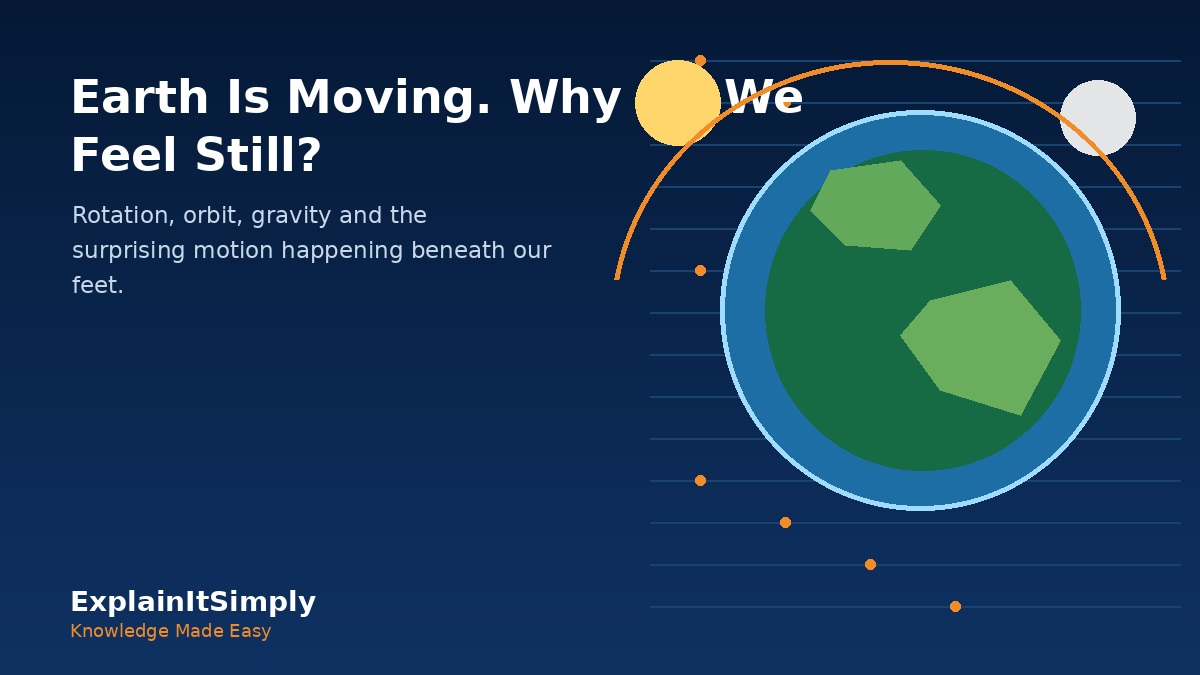 Earth is rotating and orbiting while the whole Solar System moves, yet the motion feels calm because we travel with it.Look closer
Look beneath Earth's motion
The surprising part is not that Earth moves. It is that the movement is so steady, shared and familiar that our bodies treat it as normal.
The story beginsYou are moving before you even leave your chair
Sit quietly and look around. The floor feels still, the walls do not slide away and a cup remains safely on the table. Yet you are travelling with Earth as it rotates, moves around the Sun and follows the Sun through the galaxy. The numbers are enormous, but your body does not feel a constant rush of speed.
The reason is that human bodies feel changes in motion more strongly than steady shared motion. A sudden car turn pushes you sideways. A lift beginning to move changes the feeling in your stomach. Earth's movement is smooth, and the ground, air, oceans, buildings and people are all travelling together.
◉
The simplest answer
We do not feel Earth's speed because we share its smooth motion. Gravity keeps us attached to the planet, and there is no sudden acceleration throwing everyday objects in a different direction.
Three motions are happening at the same time
Earth rotates around an imaginary line through the North and South Poles. One full rotation takes roughly a day and creates the cycle of daylight and darkness. At the same time, Earth travels around the Sun. One orbit takes roughly a year. Beyond that, the Sun and the Solar System are also moving through the Milky Way.
Speed alone does not create the feeling of being pushed. A smooth aircraft can travel quickly while a passenger walks down the aisle normally. You notice the take-off, turbulence and landing because those involve changes in speed or direction. Earth's movement is vast but steady on the scale of everyday human experience.
↻
Rotation
Earth turns from west to east. As your location turns toward the Sun, morning arrives. As it turns away, evening and night follow.
☉
Orbit
Gravity pulls Earth toward the Sun while Earth's sideways motion keeps it continually falling around the Sun rather than straight into it.
↓
Gravity
Gravity pulls matter toward Earth's centre. It keeps people, oceans and the atmosphere close to the planet while Earth moves.
☾
The Moon
The Moon orbits Earth while the Earth–Moon system orbits the Sun. The changing positions produce phases and other visible patterns.
One ordinary day on a moving planet
The sky appears to change around us, but much of the daily story comes from Earth turning.
Before sunrise
Your location is on the side turning toward sunlight. The sky begins to brighten even before the Sun appears above the horizon.
Morning arrives
Earth's rotation brings the Sun into view. The Sun looks as if it is climbing, but your part of Earth is turning toward it.
Midday
The Sun reaches its highest apparent point. Your location faces more directly toward the Sun than it did in the morning.
Evening
Earth continues rotating. Your location turns away from direct sunlight, producing sunset and the darker sky.
Night
You face away from the Sun, but Earth does not stop. It continues rotating and moving along its orbit while stars become visible.
How can a day on Venus be longer than a year on Venus?
Venus rotates extremely slowly. One full turn on its axis takes longer than one complete trip around the Sun. That means Venus finishes its year before it finishes its own rotation day.
Someone hearing this for the first time naturally asks, ‘What? How can a year finish before a day?' The answer is that a day and a year measure different motions. A day comes from rotation; a year comes from orbit. Earth rotates quickly compared with its orbit, while Venus rotates so slowly that the order feels backwards to us. Space has a sense of humour: on Venus, waiting for tomorrow could take longer than waiting for next year.
Where this appears in real lifeClues of Earth's movement in normal life
You may not feel the planet moving, but the evidence surrounds you every day.
☀
Day and night
The repeating movement of sunlight across the sky is the daily result of rotation.
◔
Moon phases
The Moon's changing appearance comes from its position relative to Earth and the Sun.
⌛
Time zones
Different parts of rotating Earth face the Sun at different times, which is why local time changes across the world.
🚀
Rocket launches
A rocket must be programmed with Earth's rotation, gravity and target orbit in mind. It is not aiming at a stationary point; everything involved is already moving.
Question 1Why do we not feel Earth spinning?
Question 2What keeps the oceans from being thrown away?
Question 3How can several kinds of motion happen at once?
Detailed answers about Earth's motion
Why does a jumping person land in almost the same place?
Before jumping, the person already shares Earth's rotational motion. The surrounding air also moves with Earth. During the brief jump, that shared sideways motion continues, so the ground does not race away underneath.
Would we feel Earth if it suddenly stopped?
Yes, and the result would be catastrophic. Everything at the surface carries Earth's rotational motion. A sudden stop would not gently leave people standing still.
Does gravity cause Earth to orbit the Sun?
Gravity provides the inward pull. Earth's sideways motion prevents a direct fall into the Sun, producing a curved path that continues as an orbit.
Why are the seasons not caused by Earth being closer to the Sun?
The main cause is Earth's tilted axis. During part of the orbit, one hemisphere receives more direct sunlight and longer days while the other receives less.
Is the Sun also moving?
Yes. The Sun travels around the centre of the Milky Way, carrying the Solar System with it. There is no simple completely stationary platform in space.
Continue beyond Earth's motion
EarthEarth — Our Home
Begin with the planet's structure, atmosphere and importance to life.
Read guideGravityGravity & Orbits
Understand why planets, moons and satellites follow curved paths.
Read guideDaily skyWhy Day and Night Happen
Focus closely on rotation and the changing sky.
Read guideExplorationSpace Exploration
Follow rockets, guidance systems and human missions beyond Earth.
Read guide